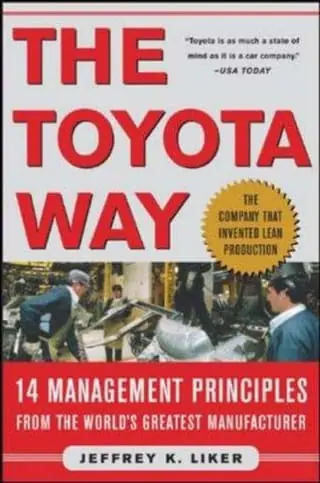
The Toyota Way summary
by Jeffrey K. Liker · 2004 · 7 key ideas · 17-minute read
Toyota’s success comes not from a toolkit of lean techniques but from fourteen management principles — long-term thinking, flowing processes, developing people and relentless problem-solving — practised as a whole culture.
Why read it
For anyone who wants to understand lean thinking at its source, or improve how a team or operation works. It explains why copying Toyota’s tools rarely works without its philosophy.
The Toyota Way in brief
Many companies have tried to copy the Toyota Production System, famous for just-in-time delivery and low inventory. Most achieve only modest, short-lived gains. Liker argues that this is because they copy the visible tools without the underlying management philosophy that makes them work.
Based on years of research and interviews, he distils that philosophy into fourteen principles grouped into four sections, often drawn as a pyramid: a long-term philosophy at the base, then the right process to produce the right results, then adding value by developing people and partners, and at the top continuous problem-solving and organisational learning.
Along the way he explains key Toyota practices: flow and pull, levelling the workload, stopping to fix problems, standardised work, visual control, going to see problems first-hand, consensus decision-making and reflection. Cases include the development of the Prius and the Lexus.
The deeper message is that Toyota treats its production system as a way of developing people who solve problems every day. The tools — kanban cards, andon cords, standard work sheets — are scaffolding; the real product is a learning organisation that keeps improving long after any single technique has been copied.
The 7 key ideas
1. Think long-term, even at short-term cost
Decide for the decade, not the quarter.
2. Flow and pull
Make what’s needed, when it’s needed.
3. See and remove waste
Look at the waiting, not just the working.
4. Stop to fix problems
Stop small problems before they become big ones.
5. Standardise to improve
No standard, no improvement.
6. Go and see for yourself
Go see. Don’t just read the report.
7. Grow people who solve problems
Ask why five times. Fix the root, not the leaf.
Read the full guide in Kinquire. Every idea with a real example, a diagram and one thing to try today, plus a quick quiz so it sticks. Free to start.
Read The Toyota WayKey takeaways
- Judge decisions against your long-term purpose, not just short-term numbers.
- Limit work in progress so problems surface quickly.
- Map your processes and remove waiting, rework and duplication.
- Make it safe and normal to stop work when something is wrong.
- Write simple standards and improve them regularly.
- Go and see problems first-hand before deciding.
Our take
The Toyota Way is the most accessible account of the philosophy behind lean production, and its argument that culture matters more than tools has been borne out by many failed lean programmes. But it is admiring to the point of idealising Toyota. The 2009–2010 recall crisis, involving unintended acceleration complaints, showed that Toyota could also stumble; Liker co-wrote Toyota Under Fire (2011) in response. Some principles, like slow consensus and lifetime employment, are hard to transplant into other cultures and industries. Still, it remains a foundational text for operational excellence.
About Jeffrey K. Liker
Jeffrey Liker is a professor of industrial and operations engineering at the University of Michigan who has studied Toyota for decades. He has written several further books on Toyota and lean management.
If you liked this
- The Goal by Eliyahu M. Goldratt
- Good to Great by Jim Collins
- Built to Last by Jim Collins and Jerry I. Porras
- The Innovator's Dilemma by Clayton M. Christensen
- Blue Ocean Strategy by W. Chan Kim and Renée Mauborgne
- Good Strategy Bad Strategy by Richard Rumelt