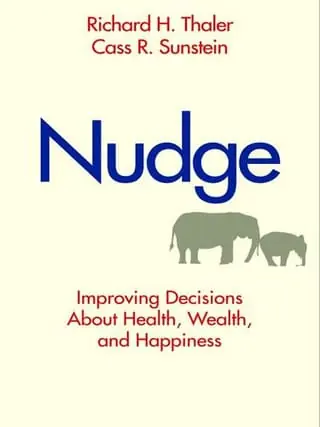
Nudge summary
by Richard H. Thaler and Cass R. Sunstein · 2008 · 7 key ideas · 18-minute read
Because every choice is presented somehow, we can design that presentation to help people make better decisions without taking any options away.
Why read it
For anyone who designs forms, products, policies or even a kitchen: it shows how small details of presentation shape big decisions, and how to use that power responsibly.
Nudge in brief
Nudge starts from a simple observation: real people are not the perfectly rational calculators of economics textbooks. The authors call those imaginary beings Econs and the rest of us Humans. Humans anchor on irrelevant numbers, stick with defaults, follow the crowd, and struggle with choices whose costs come now and benefits much later.
Since Humans are swayed by how choices are presented, whoever arranges those choices, a choice architect, inevitably influences the outcome. There is no neutral design. A cafeteria must put some food first; a pension form must have some default. The question is not whether to influence people, but how.
Thaler and Sunstein propose libertarian paternalism: arrange choices to steer people toward what they themselves would judge to be better, while leaving them completely free to choose otherwise. A nudge must be easy and cheap to avoid. Banning junk food is not a nudge; putting fruit at eye level is.
The second half applies the idea to retirement saving, health, organ donation, the environment and more. Automatic enrollment and escalating savings plans dramatically raise saving. Good feedback, sensible defaults and simpler choices help people avoid predictable mistakes. The book ends by defending its approach as a middle way between rigid mandates and leaving people to fend for themselves.
The 7 key ideas
1. Humans, not Econs
You're a Human, not an Econ. Design for that.
2. There is no neutral design
Someone always arranges the cafeteria. Make it on purpose.
3. Libertarian paternalism
Make the good choice easy, never the only choice.
4. Defaults are destiny
Doing nothing is a choice someone else made for you.
5. Save More Tomorrow
Save from tomorrow's raise and today never feels the pinch.
6. Following the herd
Tell people what most people do, if most people do it well.
7. The NUDGES toolkit
Don't blame the Human. Fix the design.
Read the full guide in Kinquire. Every idea with a real example, a diagram and one thing to try today, plus a quick quiz so it sticks. Free to start.
Read NudgeKey takeaways
- Assume people will act on autopilot, and design choices so autopilot leads somewhere good.
- Choose defaults deliberately: they are what most people will end up with.
- Commit future gains (like pay rises) to good habits before you feel them as losses.
- Use honest social norms: tell people how many others already do the right thing.
- Design to expect error rather than blaming people for predictable mistakes.
- Watch out for sludge: friction designed to work against you.
Our take
Nudge gave governments and businesses a practical vocabulary, and dozens of countries set up behavioral teams in its wake. Its best tools, especially defaults and automatic enrollment, have held up well. But later research has been more sobering about many other nudges: when results from many studies are pooled and corrected for publication bias, average effects look much smaller than early headline results. Critics also worry about manipulation, who decides what is 'better', and whether nudges distract from stronger reforms. The book is strongest as a design manual, weaker as a cure-all.
About Richard H. Thaler and Cass R. Sunstein
Richard Thaler is a University of Chicago economist who won the 2017 Nobel Prize in economics for his work in behavioral economics. Cass Sunstein is a Harvard legal scholar who led the White House Office of Information and Regulatory Affairs under President Obama.
If you liked this
- Misbehaving by Richard H. Thaler
- Thinking, Fast and Slow by Daniel Kahneman
- Influence by Robert B. Cialdini
- Predictably Irrational by Dan Ariely
- The Psychology of Money by Morgan Housel
- Rich Dad Poor Dad by Robert T. Kiyosaki