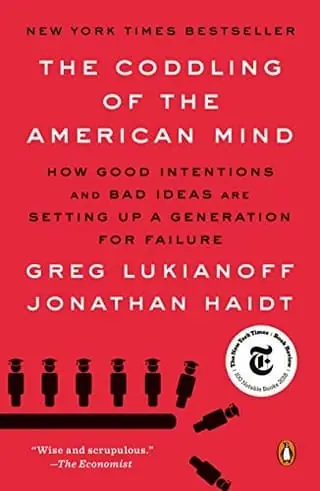
The Coddling of the American Mind summary
by Greg Lukianoff and Jonathan Haidt · 2018 · 7 key ideas · 18-minute read
Three bad ideas, that we are fragile, that feelings are always right and that life is a battle of good against evil, are harming young people and campus culture.
Why read it
For parents, educators and students who want to understand rising anxiety and conflicts over speech on campus. Its toolkit from cognitive behavioural therapy is useful far beyond universities.
The Coddling of the American Mind in brief
The book grew out of a 2015 article in The Atlantic. Lukianoff and Haidt noticed a change on American campuses around 2013: students increasingly asked to be protected from words and ideas they found upsetting, and some speakers were disinvited or shouted down. They argue this shift reflects three 'Great Untruths' that contradict ancient wisdom and modern psychology.
The untruths are: what doesn't kill you makes you weaker (fragility), always trust your feelings (emotional reasoning), and life is a battle between good people and evil people (us versus them). Each, they say, makes people more anxious and divided, and each is the opposite of what cognitive behavioural therapy teaches.
The authors then show these ideas in action, through campus incidents involving protests, disinvitations and call-out culture. They describe a culture of 'safetyism', in which safety, including emotional safety, becomes a sacred value that overrides other concerns, and they argue it leaves students less prepared for the disagreements of adult life.
Finally, they identify six interacting causes, including political polarisation, rising teen anxiety and depression, overprotective parenting, the decline of free play, growing university bureaucracy, and a passion for justice combined with new ideas about what justice requires. They end with practical advice for parents, schools and universities.
The 7 key ideas
1. The untruth of fragility
Prepare the child for the road, not the road for the child.
2. The untruth of emotional reasoning
Feelings are real. They're not always right.
3. The untruth of us versus them
The line between good and evil runs through every heart.
4. Safetyism
Safety matters. Safety above everything stunts growth.
5. The six causes
Six threads, one knot.
6. Let kids play
Play is practice for being an adult.
7. Wiser kids, wiser campuses
Prepare the mind for discomfort, and discomfort loses its power.
Read the full guide in Kinquire. Every idea with a real example, a diagram and one thing to try today, plus a quick quiz so it sticks. Free to start.
Read The Coddling of the American MindKey takeaways
- Let children and yourself face manageable challenges rather than avoiding them.
- Question your feelings with CBT techniques before treating them as facts.
- Assume others are mistaken rather than evil, and argue accordingly.
- Protect unstructured play and real-world independence for children.
- Seek out ideas you disagree with and practise charitable disagreement.
Our take
The Coddling of the American Mind gave clear names to real trends and offered genuinely useful tools from cognitive behavioural therapy. Its causal story is plausible but hard to test, and critics argue it relies on vivid campus incidents that may not represent most students, overstates a free speech crisis and pays too little attention to real discrimination, economic pressures and student debt. Some also question its link between smartphones and anxiety. Supporters say later surveys of self-censorship vindicated many of its worries. Its personal advice holds up well whatever one thinks of its diagnosis.
About Greg Lukianoff and Jonathan Haidt
Greg Lukianoff is a lawyer and president of FIRE, an American organisation that defends free speech, especially on campuses. Jonathan Haidt is a social psychologist at New York University and author of The Righteous Mind.
If you liked this
- The Anxious Generation by Jonathan Haidt
- The Righteous Mind by Jonathan Haidt
- Antifragile by Nassim Nicholas Taleb
- Factfulness by Hans Rosling with Ola Rosling and Anna Rosling Rönnlund
- Outliers by Malcolm Gladwell
- David and Goliath by Malcolm Gladwell