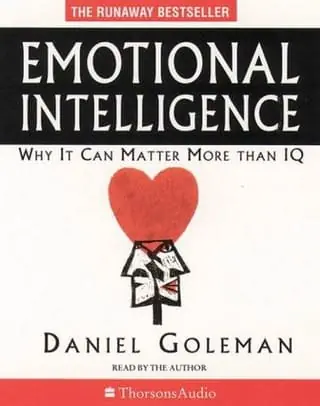
Emotional Intelligence summary
by Daniel Goleman · 1995 · 8 key ideas · 21-minute read
How well you notice, manage and use emotions, your own and other people's, shapes your life as much as raw intellect, and unlike IQ, these skills can be learned.
Why read it
For anyone who has ever been brilliant on paper but derailed by a temper, a worry or a misread colleague. It gives a clear map of emotional skills and why they matter at home, work and school.
Emotional Intelligence in brief
Goleman starts from a puzzle: why do people with high IQs sometimes flounder while those with modest IQs do surprisingly well? His answer is a set of abilities he calls emotional intelligence: self-awareness, impulse control, persistence, motivation, empathy and social skill. He argues that IQ explains only part of life success, leaving room for many other factors, and that emotional skills are among the most important.
The book first explains the emotional brain. Drawing on Joseph LeDoux's research, Goleman shows how the amygdala can trigger a reaction before the thinking brain has fully understood what's happening, producing the emotional hijackings that make us say or do things we regret.
He then sets out five domains of emotional intelligence, based on the work of psychologists Peter Salovey and John Mayer: knowing your emotions, managing them, motivating yourself, recognising emotions in others, and handling relationships. Each is illustrated with research on anger, worry, delay of gratification, optimism, empathy and social skill.
Later chapters apply these ideas to marriage, the workplace and health, showing how emotional habits can make or break relationships and careers. Goleman draws especially on John Gottman's research on couples and on studies of how stress and distress affect the body.
Finally, Goleman argues that emotional skills are not fixed. Temperament matters, but the brain stays plastic, especially in childhood, and emotional literacy can be taught. He calls for schools to make social and emotional learning a regular part of education, teaching children to name feelings, manage impulses and resolve conflicts as deliberately as they learn maths.
The 8 key ideas
1. The emotional hijack
Feel it fast, act on it slow.
2. Five domains of emotional intelligence
Notice, manage, motivate, read, relate.
3. Name it to manage it
If you can name it, you can tame it.
4. Cool anger instead of venting it
Venting fans the fire. Cooling puts it out.
5. Delay gratification, stay hopeful
Wait for two marshmallows; explain setbacks as temporary.
6. Empathy reads what isn't said
Listen to the music, not just the lyrics.
7. Complain, don't criticise
Name the act, not the person.
8. Emotional skills can be taught
Feelings are a language. Anyone can learn it.
Read the full guide in Kinquire. Every idea with a real example, a diagram and one thing to try today, plus a quick quiz so it sticks. Free to start.
Read Emotional IntelligenceKey takeaways
- When you feel a surge, pause and breathe before responding.
- Name your feelings precisely, several times a day.
- Cool anger with time and distraction instead of venting.
- Explain setbacks as temporary and fixable, not as personal flaws.
- Read tone and body language, not just words.
- Raise problems as specific complaints, never as attacks on character.
Our take
Emotional Intelligence put emotions on the agenda in schools and workplaces and helped launch the social and emotional learning movement. Its core message, that managing feelings and reading others matter, is sound. But critics say Goleman's version of EI is a broad mix of traits (self-control, optimism, empathy, motivation) rather than one coherent ability, and that the book's subtitle overstated the case: carefully measured EI predicts outcomes only modestly beyond IQ and personality. Goleman wrote that IQ explains at best around 20% of life success, but that leaves room for many factors besides EI. Some of the neuroscience is now dated.
About Daniel Goleman
Daniel Goleman is a psychologist who for many years reported on the brain and behavioural sciences for The New York Times. He co-founded the Collaborative for Academic, Social, and Emotional Learning (CASEL), which promotes emotional skills in schools.
If you liked this
- Feeling Good by David D. Burns
- The Seven Principles for Making Marriage Work by John M. Gottman and Nan Silver
- Quiet by Susan Cain
- Thinking, Fast and Slow by Daniel Kahneman
- Predictably Irrational by Dan Ariely
- The Happiness Hypothesis by Jonathan Haidt