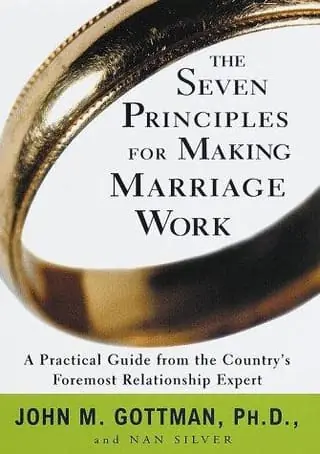
The Seven Principles for Making Marriage Work summary
by John M. Gottman and Nan Silver · 1999 · 7 key ideas · 18-minute read
Happy couples aren't the ones who never fight — they're the ones whose everyday friendship is strong enough to absorb conflict.
Why read it
For anyone in a long-term relationship who wants research-based habits, not just good intentions. It shows what to watch out for and what to build, day by day.
The Seven Principles for Making Marriage Work in brief
Gottman spent years observing couples in his research lab — watching them talk, argue and simply spend time together while measuring their physiology. From these observations he claims he can predict, with high accuracy, which couples will divorce. The warning signs aren't fights as such, but how couples fight and what their everyday interactions look like.
The sharpest predictors are four corrosive behaviours he calls the Four Horsemen: criticism, contempt, defensiveness and stonewalling. Add harsh openings to arguments, physical 'flooding' and failed attempts to repair, and a marriage is in trouble. Contempt, in his view, is the single most damaging.
The heart of the book is his claim that strong marriages rest on a deep friendship. His first three principles build that friendship: know each other's inner worlds, nurture fondness and admiration, and turn toward each other's small bids for attention. The fourth asks partners to accept each other's influence.
The last three principles deal with conflict and meaning. Solve the problems that can be solved, using gentle startups and repair. Accept that most problems are perpetual, and move from gridlock to dialogue by understanding the dreams beneath each position. Finally, build a shared sense of meaning through rituals, roles and goals.
The 7 key ideas
1. The Love Lab's prediction
It's not whether you fight, but how.
2. Beware the Four Horsemen
Complain about the action, never attack the person.
3. Build your love maps
Keep updating the map of the person you love.
4. Fondness and turning toward
Small moments, often, beat grand gestures, rarely.
5. Accept influence
Share power or fight over it forever.
6. Most problems are perpetual
Don't solve the unsolvable — understand it.
7. Create shared meaning
Rituals turn two lives into one story.
Read the full guide in Kinquire. Every idea with a real example, a diagram and one thing to try today, plus a quick quiz so it sticks. Free to start.
Read The Seven Principles for Making Marriage WorkKey takeaways
- Notice the Four Horsemen in your arguments and replace them.
- Keep updating your knowledge of your partner's inner world.
- Turn toward small bids for attention every day.
- Look for the reasonable part of your partner's view.
- Sort conflicts into solvable and perpetual — and explore the dreams behind the perpetual ones.
- Build at least one weekly ritual of connection.
Our take
Gottman brings unusual rigour to a field full of opinion, and his practical ideas — the Four Horsemen, turning toward bids, perpetual problems — have proved genuinely useful to millions and influential among therapists. But some of his headline numbers, especially the claim of predicting divorce with over 90 percent accuracy, have been criticized as overstating what the data show. Much of the research comes from his own lab, and early samples were mostly married, middle-class, heterosexual American couples. The book also says relatively little about abuse, mental illness or structural pressures like money and work. Still, it remains one of the most evidence-informed relationship books available.
About John M. Gottman and Nan Silver
John Gottman is an American psychologist who spent decades observing couples at the University of Washington and co-founded the Gottman Institute. Nan Silver is a writer who has co-authored several books with him.
If you liked this
- Hold Me Tight by Sue Johnson
- Attached by Amir Levine and Rachel Heller
- The 5 Love Languages by Gary Chapman
- Crucial Conversations by Kerry Patterson, Joseph Grenny, Ron McMillan and Al Switzler
- How to Win Friends and Influence People by Dale Carnegie
- Nonviolent Communication by Marshall B. Rosenberg