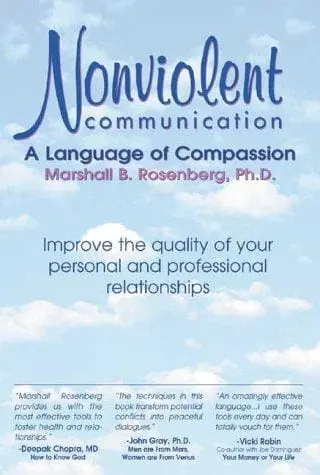
Nonviolent Communication summary
by Marshall B. Rosenberg · 1999 · 8 key ideas · 20-minute read
Replace blame and judgment with four honest steps — what I observe, what I feel, what I need, what I'm asking for — and listen for the same in others.
Why read it
For anyone whose arguments keep circling, or who wants to say hard things without wounding people. Its four-part model is simple enough to use tonight and deep enough to practise for years.
Nonviolent Communication in brief
Rosenberg begins with a puzzle: why do people who mean well end up hurting each other with words? His answer is that we have learned a language of judgment. We diagnose, label, compare, blame and demand, and these habits cut us off from our own feelings and from the humanity of the person in front of us. He calls the alternative 'nonviolent', borrowing Gandhi's sense of the word.
The method has four components. Observe what is actually happening without mixing in evaluation. Name the feeling it stirs in you. Identify the need behind that feeling. Make a clear, doable request. The same four steps work in reverse when listening: you try to sense the other person's observations, feelings, needs and requests, even when they are expressed as attacks.
A central claim is that other people's actions can trigger our feelings, but the cause lies in our own needs. Taking responsibility for this frees us from blaming others and from being controlled by blame. It also makes our requests easier to hear, because they no longer arrive packaged as accusations.
Rosenberg then applies the model to empathy, anger, self-compassion, conflict resolution and appreciation. Anger becomes a signal of unmet needs rather than a judgment to unleash. Self-criticism becomes a chance to mourn and learn. Even praise is reframed: instead of judging people as good, you tell them which of your needs their action met.
The 8 key ideas
1. Four honest steps
Observe, feel, need, request.
2. The language that alienates
Describe actions, not people.
3. Observe without evaluating
If a camera couldn't record it, it's an evaluation.
4. Feelings, not disguised thoughts
Name what's inside you, not what they did.
5. Needs are the root
What they did is the trigger; your need is the cause.
6. Requests, not demands
If 'no' isn't allowed, it was a demand.
7. Receive with empathy
Every attack is a clumsy request.
8. Anger and gratitude, reframed
Anger hides a need; gratitude names one.
Read the full guide in Kinquire. Every idea with a real example, a diagram and one thing to try today, plus a quick quiz so it sticks. Free to start.
Read Nonviolent CommunicationKey takeaways
- Describe actions a camera could record before saying anything else.
- Name feelings with words that don't accuse anyone.
- Look for the need behind your feelings, and theirs.
- Turn complaints into concrete, positive requests.
- When attacked, guess the unmet need aloud instead of defending.
- Thank people by naming the action, the need it met and your feeling.
Our take
Nonviolent Communication offers a genuinely useful discipline: separating observations from judgments and naming feelings and needs reliably lowers defensiveness, and it has been widely adopted in mediation, schools and couples work. But the method can turn stilted and formulaic, and some people use its vocabulary to mask control or avoid owning plain disagreement. Its claim that others never cause our feelings can feel dismissive to people who have been genuinely wronged. Formal research on NVC is still limited and mostly small-scale. Practised with warmth rather than as a script, it remains a powerful way to communicate.
About Marshall B. Rosenberg
Marshall Rosenberg was an American psychologist who studied with Carl Rogers and founded the Center for Nonviolent Communication. He taught his method in workshops and mediations around the world.
If you liked this
- Crucial Conversations by Kerry Patterson, Joseph Grenny, Ron McMillan and Al Switzler
- Difficult Conversations by Douglas Stone, Bruce Patton and Sheila Heen
- Hold Me Tight by Sue Johnson
- How to Talk So Kids Will Listen & Listen So Kids Will Talk by Adele Faber and Elaine Mazlish
- How to Win Friends and Influence People by Dale Carnegie
- The 5 Love Languages by Gary Chapman