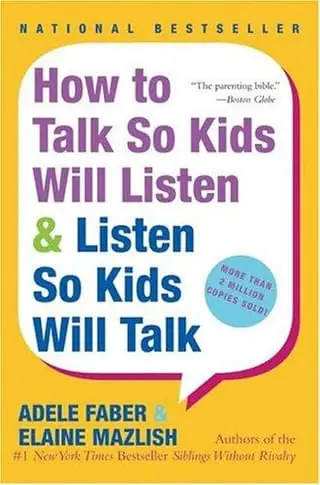
How to Talk So Kids Will Listen & Listen So Kids Will Talk summary
by Adele Faber and Elaine Mazlish · 1980 · 7 key ideas · 17-minute read
Children cooperate when their feelings are acknowledged and they're treated with respect, so swap lectures, threats and labels for simple, respectful words.
Why read it
For parents, teachers and anyone who spends time with children. Its practical scripts work just as well with teenagers, partners and colleagues.
How to Talk So Kids Will Listen & Listen So Kids Will Talk in brief
Faber and Mazlish start from a simple observation drawn from their parenting groups: how children feel shapes how they behave. When children feel understood, they behave better. When their feelings are dismissed, they become more upset and less cooperative. Yet adults routinely deny, argue with or lecture away children's feelings, usually with good intentions.
The book offers concrete skills, illustrated with cartoon strips contrasting unhelpful and helpful responses. Help children with feelings by listening fully, acknowledging, naming emotions and granting wishes in fantasy. Engage cooperation by describing problems, giving information and stating your own feelings rather than blaming, threatening or commanding.
Rather than punishing, the authors suggest expressing strong disapproval without attacking character, showing children how to make amends, offering choices and solving problems together. They encourage autonomy by letting children make choices and struggle a little, and they recommend describing what a child did instead of evaluating it with empty praise.
The final chapter tackles labels. Children who are cast as 'the lazy one' or 'the troublemaker' tend to live up to the role. Adults can free them by showing them new pictures of themselves. Throughout, the aim is a relationship built on respect, where children learn to cooperate rather than simply obey.
The 7 key ideas
1. Accept feelings first
Feelings first, fixes later.
2. Invite cooperation without nagging
Describe the problem, not the child.
3. Alternatives to punishment
Repair teaches; punishment distracts.
4. Solve problems together
Solve it with them, not for them.
5. Encourage autonomy
Let them struggle a little; it builds them a lot.
6. Describe, don't evaluate
Describe the deed; let them draw the conclusion.
7. Free children from roles
Children grow into the pictures we hold up.
Read the full guide in Kinquire. Every idea with a real example, a diagram and one thing to try today, plus a quick quiz so it sticks. Free to start.
Read How to Talk So Kids Will Listen & Listen So Kids Will TalkKey takeaways
- Name a child's feeling before you try to change their behaviour.
- Replace nagging with a description or a single word.
- Swap punishment for a way to make amends.
- Problem-solve recurring battles together on paper.
- Answer questions with 'What do you think?'
- Describe what a child did instead of saying 'Great job'.
Our take
This book has stayed in print for decades because its techniques are simple, respectful and often immediately effective. Its focus on acknowledging feelings, describing rather than judging and inviting cooperation fits well with later research on emotion coaching, autonomy and praise. Its limits: the scripts can sound stilted if used mechanically; the examples reflect a particular, largely middle-class family context; and it offers less for children with serious behavioural, developmental or mental-health needs. Some readers find it light on handling persistent defiance. But as a guide to everyday communication with children, it remains one of the most practical and humane available.
About Adele Faber and Elaine Mazlish
Adele Faber and Elaine Mazlish were parents who studied with child psychologist Haim Ginott and went on to lead parenting workshops. They wrote several books together, including Siblings Without Rivalry.
If you liked this
- Nonviolent Communication by Marshall B. Rosenberg
- How to Win Friends and Influence People by Dale Carnegie
- Crucial Conversations by Kerry Patterson, Joseph Grenny, Ron McMillan and Al Switzler
- The 5 Love Languages by Gary Chapman
- Attached by Amir Levine and Rachel Heller
- Hold Me Tight by Sue Johnson