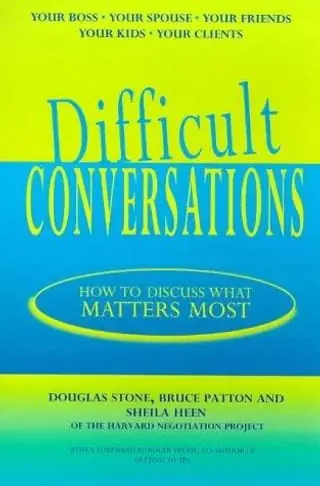
Difficult Conversations summary
by Douglas Stone, Bruce Patton and Sheila Heen · 1999 · 7 key ideas · 17-minute read
Every hard conversation is really three conversations — about what happened, about feelings and about identity — and handling all three turns arguments into learning.
Why read it
For anyone who dreads telling a colleague, friend or family member something they don't want to hear. It explains why these talks go wrong and gives a calmer, more curious way in.
Difficult Conversations in brief
We avoid difficult conversations because both options feel bad: raise the issue and risk a fight, or stay silent and let it fester. The authors argue we struggle because we misunderstand what these conversations are. Beneath the surface, each one is really three conversations happening at once.
The 'What Happened?' conversation is about facts, intentions and blame. Here, the authors urge us to stop arguing about who's right and explore each other's stories, to separate our intentions from our impact, and to map how each person contributed to the problem rather than assigning blame.
The Feelings conversation is about the emotions that drive the whole exchange, which we often try to leave out but which leak in anyway. The Identity conversation is about what the situation says about us: am I competent, good, worthy of love? When our identity feels threatened, we lose balance.
Having mapped these, the book shows how to start well — from a neutral 'third story' — and how to move forward by listening with real curiosity, expressing yourself clearly, and solving problems together. The shift throughout is from a 'message delivery' stance to a learning stance.
The 7 key ideas
1. Three conversations in one
Three conversations, not one.
2. Explore stories, not who's right
Replace 'How can they think that?' with 'What do they know?'
3. Separate intent from impact
Good intentions don't cancel bad impact.
4. Map contribution, not blame
Ask 'how did we get here?', not 'whose fault is it?'
5. Have your feelings
Unspoken feelings speak anyway.
6. Ground your identity
You can make a mistake without being one.
7. Begin from the third story
Start where a mediator would start.
Read the full guide in Kinquire. Every idea with a real example, a diagram and one thing to try today, plus a quick quiz so it sticks. Free to start.
Read Difficult ConversationsKey takeaways
- Prepare for all three conversations: facts, feelings, identity.
- Ask what the other person knows that you don't.
- Share impact; hold your guess about their intent lightly.
- Name your own contribution to the problem early.
- Identify the feeling you least want to admit.
- Open with the neutral 'third story' and an invitation.
Our take
Difficult Conversations is unusually wise and balanced: its three-conversation framework, the intent–impact distinction and the shift from blame to contribution are clear, durable and widely taught in workplaces and law schools. It treats emotions and identity as central rather than as noise. Its limits: its examples come largely from professional and middle-class settings, and it assumes both people are capable of good faith. It offers less guidance on dealing with someone who is manipulative, abusive or far more powerful than you. Its evidence is mostly practical experience rather than research. As a guide to everyday hard talks, it has held up very well.
About Douglas Stone, Bruce Patton and Sheila Heen
The three authors worked with the Harvard Negotiation Project, which developed the approach behind the classic Getting to Yes. Bruce Patton co-authored later editions of that book, and Stone and Heen went on to write Thanks for the Feedback.
If you liked this
- Crucial Conversations by Kerry Patterson, Joseph Grenny, Ron McMillan and Al Switzler
- Nonviolent Communication by Marshall B. Rosenberg
- Getting to Yes by Roger Fisher and William Ury
- How to Win Friends and Influence People by Dale Carnegie
- The 5 Love Languages by Gary Chapman
- Attached by Amir Levine and Rachel Heller