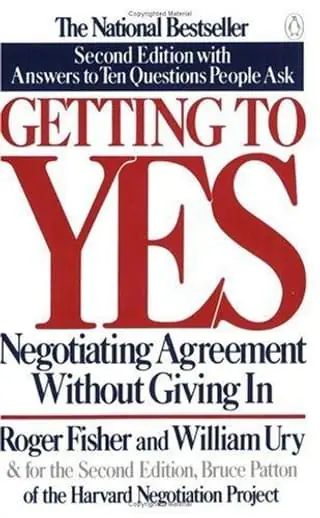
Getting to Yes summary
by Roger Fisher and William Ury · 1981 · 7 key ideas · 18-minute read
Stop haggling over positions: separate the people from the problem, focus on underlying interests, invent options for mutual gain, insist on objective criteria — and always know your best alternative.
Why read it
The classic, most widely used framework for negotiating fairly and effectively, useful for business deals, workplace conflicts and family disagreements alike.
Getting to Yes in brief
Fisher and Ury begin with a problem everyone recognises: most negotiations become a contest of positions. Each side stakes out a demand and concedes grudgingly. This produces unwise agreements, wastes time and damages relationships. Being ‘soft’ to keep the peace is no better — it gets you exploited by hard bargainers.
Their alternative is principled negotiation, or negotiation on the merits. It rests on four points. Separate the people from the problem. Focus on interests, not positions. Invent options for mutual gain before deciding. Insist that the result be based on some objective standard.
The authors then answer the obvious objections. What if the other side is more powerful? Know your BATNA — your best alternative to a negotiated agreement — and improve it. What if they won't play? Use ‘negotiation jujitsu’ to redirect attacks onto the problem. What if they use dirty tricks? Name the tactic and negotiate about the rules of the game.
The overall message is that you don't have to choose between getting what you want and being decent. By working together on the problem, side by side, both parties can reach agreements that are wiser, more efficient and kinder to the relationship than positional haggling ever produces.
The 7 key ideas
1. Don't bargain over positions
Be soft on the person, hard on the problem.
2. Separate the people from the problem
Side by side, not face to face.
3. Focus on interests, not positions
Positions are what people say; interests are why.
4. Invent options for mutual gain
Invent first, decide later.
5. Insist on objective criteria
Yield to principle, never to pressure.
6. Know your BATNA
Your power is your plan B.
7. Negotiation jujitsu
Don't push back — invite and redirect.
Read the full guide in Kinquire. Every idea with a real example, a diagram and one thing to try today, plus a quick quiz so it sticks. Free to start.
Read Getting to YesKey takeaways
- Before any negotiation, write down your interests and guess theirs.
- Know and improve your BATNA before you sit down.
- Brainstorm several options before choosing one.
- Bring objective standards to price and fairness disputes.
- Address emotions and perceptions directly, separately from the substance.
- Answer attacks with questions and silence, not counter-attacks.
Our take
Getting to Yes is concise, humane and enormously influential; terms like BATNA and ‘interests not positions’ are now standard. Its strengths are clarity and a credible alternative to haggling. Its limits: critics argue it underestimates how emotional and irrational negotiators can be, offers less guidance for purely distributive deals over price, and can be naive about power and bad faith. Some details of its famous examples are simplified. Still, its core advice on interests, options and alternatives remains the foundation most later negotiation books build on or argue against.
About Roger Fisher and William Ury
Roger Fisher was a Harvard Law School professor and William Ury a negotiation scholar; together they helped found the Harvard Negotiation Project. Later editions added co-author Bruce Patton.
If you liked this
- Never Split the Difference by Chris Voss
- Bargaining for Advantage by G. Richard Shell
- Difficult Conversations by Douglas Stone, Bruce Patton and Sheila Heen
- How to Win Friends and Influence People by Dale Carnegie
- Crucial Conversations by Kerry Patterson, Joseph Grenny, Ron McMillan and Al Switzler
- Nonviolent Communication by Marshall B. Rosenberg