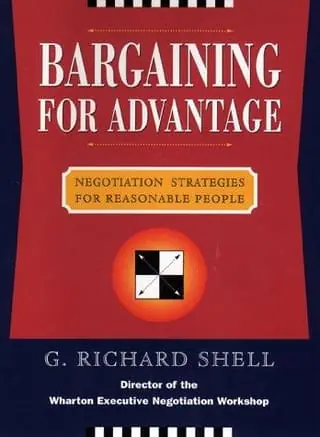
Bargaining for Advantage summary
by G. Richard Shell · 1999 · 8 key ideas · 19-minute read
Good negotiators know their own style, prepare around six foundations — goals, standards, relationships, the other side's interests and leverage — and adapt their strategy to the situation rather than following one formula.
Why read it
For anyone who wants a thorough, research-informed guide to negotiation that respects both cooperative and competitive approaches, from salary talks to business deals.
Bargaining for Advantage in brief
Shell's starting point is that there is no single best way to negotiate. Some books say be cooperative; others say be tough. Shell argues that effective negotiators start by understanding their own natural style, then prepare carefully and adapt to the situation and the people involved. He calls this information-based bargaining.
The first half of the book sets out six foundations of effective negotiation: your bargaining style, your goals and expectations, authoritative standards and norms, relationships, the other party's interests, and leverage. Each is a lens for preparing, and together they explain why some negotiators consistently do better.
The second half walks through the negotiation process in four stages: preparing a strategy, exchanging information, opening and making concessions, and closing and gaining commitment. Shell offers a simple matrix for choosing a strategy based on how much is at stake and how much the relationship matters.
Shell closes with ethics. He describes three common attitudes — negotiation as a game with its own rules, as an arena where you should always do right, and as a place where reputation makes honesty pay — and urges readers to adopt a personal standard that keeps them well clear of deception.
The 8 key ideas
1. Know your bargaining style
Know your style, then stretch it.
2. Aim high with specific goals
Aim at the goal, not the floor.
3. Use standards they respect
Their own rules are your best argument.
4. Relationships run on reciprocity
Give a little first to build a pattern.
5. Find their interests — and the common ground
Make their yes easy to explain.
6. Leverage: who has more to lose?
Leverage is who needs the deal more — today.
7. Open optimistically, concede deliberately
Open high with a reason; concede in shrinking steps.
8. Match strategy to the situation
Stakes and relationship decide the style.
Read the full guide in Kinquire. Every idea with a real example, a diagram and one thing to try today, plus a quick quiz so it sticks. Free to start.
Read Bargaining for AdvantageKey takeaways
- Identify your default negotiation style and its blind spots.
- Write a specific, optimistic, justifiable goal alongside your walk-away point.
- Find standards the other side has already endorsed.
- Map what each side loses with no deal, and work to shift that balance.
- Plan your opening and concessions in advance, in decreasing steps.
- Choose your approach based on stakes and relationship.
Our take
Bargaining for Advantage is one of the most balanced, well-grounded negotiation books available. It respects both competitive and cooperative approaches, draws on research and real cases, and gives practical tools for preparation. Its thoroughness can make it feel dense compared with punchier books, and some readers want more scripts for the heat of the moment. Its ethical discussion is thoughtful but leaves much to individual judgment. Overall, it remains a strong, durable foundation — especially paired with Getting to Yes for collaboration and Never Split the Difference for in-the-moment tactics.
About G. Richard Shell
G. Richard Shell is a professor at the Wharton School of the University of Pennsylvania, where he teaches negotiation and directs the Wharton Executive Negotiation Workshop.
If you liked this
- Getting to Yes by Roger Fisher and William Ury
- Never Split the Difference by Chris Voss
- Influence by Robert B. Cialdini
- How to Win Friends and Influence People by Dale Carnegie
- Crucial Conversations by Kerry Patterson, Joseph Grenny, Ron McMillan and Al Switzler
- Nonviolent Communication by Marshall B. Rosenberg