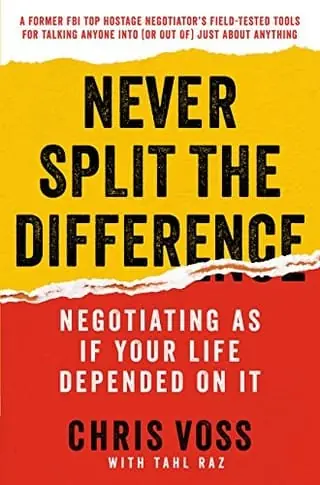
Never Split the Difference summary
by Chris Voss · 2016 · 8 key ideas · 19-minute read
Negotiation is driven by emotion, not logic, so the winning tools are tactical empathy, careful listening and questions that let the other side feel in control while you steer.
Why read it
For anyone who asks for a raise, buys a car, manages people or handles conflict. It turns hostage-negotiation techniques into short, practical tools you can use in your next conversation.
Never Split the Difference in brief
Voss opens by challenging the classic Harvard model of negotiation, which treats people as rational problem-solvers. In his experience bargaining with kidnappers and bank robbers, people are emotional, irrational and driven by fears and needs they rarely state. Effective negotiation, he argues, starts by understanding those emotions — a skill he calls tactical empathy.
Most of the book is a toolkit for drawing people out. Mirror their words so they keep talking. Label their emotions so they feel understood and calmer. Pre-empt their objections with an accusation audit. Seek a ‘no’ rather than a cheap ‘yes’, and aim for the moment they say ‘that's right’ because you summarised their world accurately.
Once you understand the other side, you steer with calibrated questions — open ‘how’ and ‘what’ questions that give them the illusion of control while making them solve your problem. You guard against false agreement by checking how they will implement the deal, and you notice who really holds the power to say yes.
Finally Voss covers hard bargaining: anchoring emotions, using deadlines and the word ‘fair’ carefully, and a structured offer system named after a former CIA officer. He ends with black swans — hidden pieces of information that, once found, change the whole negotiation. Throughout, his message is that compromise is often a lazy outcome, and that listening is the most underused weapon.
The 8 key ideas
1. Tactical empathy beats logic
Understand first; argue later — if at all.
2. Mirror to keep them talking
Repeat, pause, and let them fill the silence.
3. Label the feeling — and the fear
Name the dragon and it shrinks.
4. Seek ‘No’, distrust ‘Yes’
‘No’ starts the conversation; ‘yes’ often ends it.
5. Aim for ‘That's right’
Hear ‘that's right’ before you try to be right.
6. Calibrated questions give an illusion of control
Ask ‘how’, and let them solve it for you.
7. Bargain hard with the Ackerman plan
65, 85, 95, 100 — and end on an odd number.
8. Hunt for black swans
When they seem crazy, you're missing information.
Read the full guide in Kinquire. Every idea with a real example, a diagram and one thing to try today, plus a quick quiz so it sticks. Free to start.
Read Never Split the DifferenceKey takeaways
- Mirror and label before you argue; let silence do some of the work.
- Run an accusation audit before hard conversations.
- Phrase requests so that ‘no’ is a comfortable answer.
- Summarise until you hear ‘that's right’.
- Use ‘how’ and ‘what’ questions to turn objections into shared problems.
- Plan your offers in advance rather than meeting in the middle.
Our take
Never Split the Difference is vivid, practical and full of tools you can try immediately, and its emphasis on listening and empathy is genuinely valuable. Its weaknesses: it overstates its break from earlier negotiation thinking, which also valued emotions; it relies heavily on war stories rather than systematic evidence; and some tactics, such as extreme anchors or engineered ‘no’ questions, can feel manipulative if used without real curiosity. It also leans on a hostage-negotiation frame that fits one-off adversarial deals better than long-term partnerships. Used with sincerity, its core habits travel well.
About Chris Voss
Chris Voss spent more than two decades at the FBI and served as its lead international kidnapping negotiator. He later founded a negotiation consultancy, the Black Swan Group, and wrote this book with journalist Tahl Raz.
If you liked this
- Getting to Yes by Roger Fisher and William Ury
- Bargaining for Advantage by G. Richard Shell
- Influence by Robert B. Cialdini
- Crucial Conversations by Kerry Patterson, Joseph Grenny, Ron McMillan and Al Switzler
- How to Win Friends and Influence People by Dale Carnegie
- Nonviolent Communication by Marshall B. Rosenberg