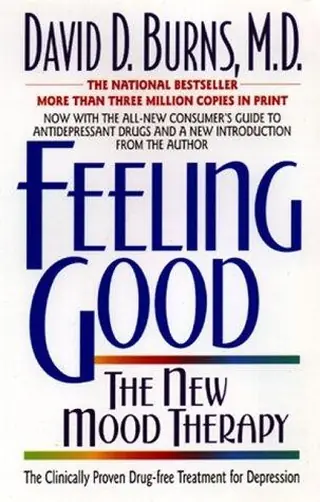
Feeling Good summary
by David D. Burns · 1980 · 8 key ideas · 20-minute read
Your moods are shaped by your thoughts, and depressed or anxious thoughts are usually distorted, so learning to spot and talk back to them can change how you feel.
Why read it
For anyone who gets stuck in low mood, self-criticism, procrastination or anger. It's a practical, exercise-based introduction to cognitive therapy; for severe or persistent depression, it works best alongside professional help.
Feeling Good in brief
Burns brings the methods of cognitive therapy, developed by Aaron Beck, to a general audience. Its core claim is simple: your feelings result from the messages you give yourself. When you're depressed, those messages are overwhelmingly negative, and crucially, they're often distorted. Change the thinking, and the mood follows.
The book names ten common thinking errors, such as all-or-nothing thinking, mind reading and 'should' statements, and gives readers tools to catch them. The central technique is writing down upsetting thoughts, identifying the distortions in them and replacing them with more realistic responses.
Burns then applies these methods to the problems that keep people stuck: low self-esteem, do-nothingism and procrastination, handling criticism, anger and guilt. In each case, he shows how distorted thoughts fuel the problem and offers practical exercises, from activity schedules to scripts for responding to criticism.
Later chapters tackle the deeper 'silent assumptions' that make people vulnerable to depression in the first place: dependence on approval or love, equating self-worth with achievement, and perfectionism. Burns argues that human worth can't be earned through success or lost through failure; it is not something you have to keep proving.
Throughout, he stresses that these are skills, not insights. Reading alone isn't enough; you have to practise the written exercises regularly, especially when you least feel like it. Later editions also include guidance on preventing relapse, on coping with hopelessness and on antidepressant medication.
The 8 key ideas
1. Your thoughts create your moods
Change the thought, and the feeling follows.
2. Ten thinking traps
Name the trap, and you're halfway out.
3. Talk back in three columns
Thoughts on paper lose their power.
4. Feelings aren't facts
A feeling is a messenger, not a judge.
5. Action comes before motivation
Don't wait to feel like it. Start, then you will.
6. Disarm criticism
Agree with the truth, and the attack loses its sting.
7. Shoulds fuel anger
Swap 'should' for 'I'd prefer'.
8. Your worth isn't earned
Dare to be average. You're worth more than your output.
Read the full guide in Kinquire. Every idea with a real example, a diagram and one thing to try today, plus a quick quiz so it sticks. Free to start.
Read Feeling GoodKey takeaways
- When your mood drops, write down the exact thought behind it.
- Name the distortion in each painful thought.
- Use the three columns: thought, distortion, rational response.
- Start tasks before you feel motivated; motivation follows action.
- Respond to criticism by finding and agreeing with the grain of truth.
- Aim for 'good enough' and stop tying your worth to performance.
Our take
Feeling Good has helped millions of readers, and bibliotherapy research supports its usefulness for mild to moderate depression. Its methods, rooted in Beck's cognitive therapy, remain central to modern CBT. Its limitations: the tone is relentlessly upbeat, some examples feel dated, and its claim that thoughts cause moods is a simplification; biology, circumstances and relationships matter too. Newer approaches, such as acceptance and commitment therapy, suggest that stepping back from thoughts can work as well as disputing them. And a book cannot replace professional care: anyone with severe depression or thoughts of self-harm should seek help from a doctor or crisis service.
About David D. Burns
David D. Burns is an American psychiatrist who worked with Aaron Beck, a founder of cognitive therapy, at the University of Pennsylvania. He later became an adjunct clinical professor at Stanford University School of Medicine.
If you liked this
- The Happiness Hypothesis by Jonathan Haidt
- Emotional Intelligence by Daniel Goleman
- The Chimp Paradox by Steve Peters
- Thinking, Fast and Slow by Daniel Kahneman
- Predictably Irrational by Dan Ariely
- Flow by Mihaly Csikszentmihalyi