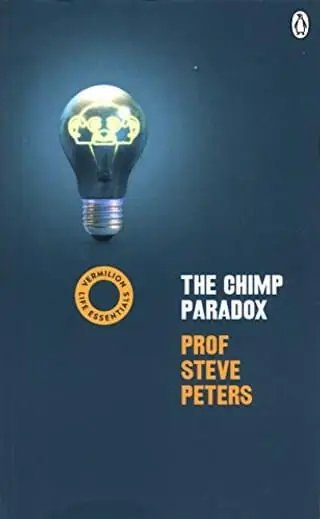
The Chimp Paradox summary
by Steve Peters · 2012 · 8 key ideas · 20-minute read
Inside your head is an emotional 'Chimp' that thinks faster and stronger than the logical you; you can't get rid of it, but you can learn to manage it.
Why read it
For anyone who reacts in ways they later regret, overthinks, or struggles with confidence under pressure. It offers a simple, memorable model of the mind that elite athletes have used.
The Chimp Paradox in brief
Peters offers a simplified model of the mind built around three characters. The Human is you: logical, evidence-based and guided by your values. The Chimp is an emotional machine, roughly linked to the brain's limbic system, that reacts to impressions and feelings. The Computer is your stored memory of beliefs and automatic behaviours, which both the Human and Chimp consult.
The paradox of the title is that the Chimp can be your best friend or your worst enemy. It's powerful, fast and acts first, and it often hijacks you before your Human has had a chance to think. You aren't responsible for the Chimp's nature, but you are responsible for managing it.
Much of the book explains how. You can let the Chimp exercise, venting its feelings in a safe place; box it with facts and truth; or calm it with a banana, a reward or distraction. You can also reprogram the Computer by removing unhelpful beliefs and installing helpful autopilots, anchored in your core values.
Peters then applies the model to the outside world: understanding other people's Chimps, choosing the people around you wisely, communicating well and handling stress. He argues that many conflicts are really two Chimps reacting to each other, and that recognising this lets you wait for the other person's Human before trying to resolve anything.
The final sections cover health, success and happiness. Peters encourages readers to define success by what they can control, such as effort and values, to keep expectations realistic, to look after their physical and mental health, and to build a stable inner foundation of chosen values and truths that steadies them when the Chimp is in turmoil.
The 8 key ideas
1. Three brains in one
Feelings first? That's the Chimp. Facts first? That's you.
2. The Chimp acts first
Don't wrestle the Chimp. Outsmart it in advance.
3. Not your fault, but your job
You didn't choose the Chimp. You do choose the owner.
4. Exercise, box and banana
Let it out, sort it out, then move on.
5. Reprogram your Computer
Catch the Gremlin. Install the Autopilot.
6. Goblins and the Stone of Life
When the Chimp storms, stand on your Stone.
7. Other people have Chimps too
Don't feed their Chimp. Wait for their Human.
8. Define success by what you control
Control the effort. Let go of the outcome.
Read the full guide in Kinquire. Every idea with a real example, a diagram and one thing to try today, plus a quick quiz so it sticks. Free to start.
Read The Chimp ParadoxKey takeaways
- Notice when your Chimp, not your Human, is reacting.
- Plan responses in advance for situations that trigger you.
- Vent briefly and safely, then calm yourself with facts.
- Replace unhelpful beliefs with rehearsed, helpful ones.
- Write down your core values and use them as an anchor.
- Define success by effort and values, not outcomes.
Our take
The Chimp Paradox gives people a vivid, practical language for their emotional reactions, which helps explain its popularity with athletes, businesses and general readers. Its strengths are simplicity and actionable tools. Its limits: the neuroscience is a metaphor rather than an accurate map of the brain, the model hasn't been tested as a scientific theory, and the metaphor can feel repetitive or childish to some readers. It also offers little guidance for serious mental health problems, where professional help is needed. As a memorable framework for everyday self-management, though, it overlaps well with established approaches like CBT and dual-process thinking.
About Steve Peters
Steve Peters is a British consultant psychiatrist who worked with British Cycling's track team during a period of major Olympic success, and later with England's football teams.
If you liked this
- Thinking, Fast and Slow by Daniel Kahneman
- The Happiness Hypothesis by Jonathan Haidt
- Feeling Good by David D. Burns
- Emotional Intelligence by Daniel Goleman
- Predictably Irrational by Dan Ariely
- Flow by Mihaly Csikszentmihalyi