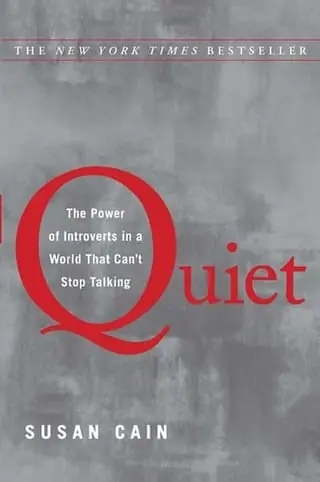
Quiet summary
by Susan Cain · 2012 · 8 key ideas · 21-minute read
Modern culture prizes the bold and talkative, but introverts bring vital strengths, and both they and the world do better when those strengths are understood instead of fixed.
Why read it
For introverts who've been told to 'speak up more', and for the extroverts who manage, teach, love or raise them. It reframes quietness as a different way of working, not a flaw.
Quiet in brief
Cain estimates that one-third to one-half of Americans are introverts, yet society is built around what she calls the Extrovert Ideal: the belief that the ideal self is gregarious, assertive and comfortable in the spotlight. She traces how this ideal arose in the early twentieth century, as a culture of character gave way to a culture of personality, and how it now shapes schools, offices and business schools.
She then challenges the New Groupthink, the belief that creativity comes from teams, open offices and brainstorming. Research suggests solitude often matters for deep work and original ideas, and that group brainstorming can produce fewer and weaker ideas than people working alone.
Next, Cain explores the biology of temperament. Highly reactive babies tend to become cautious, careful children, and introverts generally prefer lower levels of stimulation. But temperament is not destiny: through free trait theory, she shows how introverts can act out of character for things they care about, as long as they also find time to recharge.
Cain then examines how introverts and extroverts differ in their sensitivity to reward, with extroverts more drawn to the buzz of possible gains and introverts more inclined to pause and check. She shows how introverted leaders can outperform extroverted ones in the right settings, and how cultures vary in how much they value quietness and listening.
The final part offers practical advice for relationships, workplaces and parenting: how introverts and extroverts can understand each other's needs for stimulation and solitude, how to argue and socialise in ways that work for both, and how to raise quiet children by gently helping them face new situations without trying to change who they are.
The 8 key ideas
1. The Extrovert Ideal
Loud isn't the same as right.
2. Solitude feeds creativity
Think alone. Then talk together.
3. Temperament starts early
Sensitivity is a volume knob, not a defect.
4. Find your stimulation sweet spot
Know your sweet spot. Then live in it more.
5. Act out of character, then recharge
Stretch for what matters. Then return to yourself.
6. Quiet leaders listen better
The best idea in the room may not be yours.
7. Different responses to reward
Excitement says go. Caution asks: are you sure?
8. Quiet power
You don't have to be loud to be unmovable.
Read the full guide in Kinquire. Every idea with a real example, a diagram and one thing to try today, plus a quick quiz so it sticks. Free to start.
Read QuietKey takeaways
- Notice when confidence is being mistaken for competence.
- Have people think alone before group discussions.
- Track what drains and restores you, and plan around it.
- Stretch out of character for core projects, then protect recovery time.
- If you lead, speak last and listen first.
- Use quiet strengths, like persistence and depth, on causes you care about.
Our take
Quiet gave millions of people a vocabulary for something they'd felt all their lives, and its critique of brainstorming, open offices and participation-obsessed classrooms has been influential. Its strengths are warmth and well-chosen research. Its weaknesses: Cain's 'introvert' bundles together traits like sensitivity, shyness and reflectiveness that psychologists treat separately, and the book can tip into celebrating introverts at extroverts' expense. Some biological claims are simplified, and research suggests most people sit near the middle of the spectrum. Still, its central practical message, that environments should allow for different temperaments, has held up well.
About Susan Cain
Susan Cain worked as a corporate lawyer and then as a negotiation consultant before becoming a writer. Her TED talk on the power of introverts became one of the most watched talks on the platform.
If you liked this
- Emotional Intelligence by Daniel Goleman
- Deep Work by Cal Newport
- Thinking, Fast and Slow by Daniel Kahneman
- Predictably Irrational by Dan Ariely
- The Happiness Hypothesis by Jonathan Haidt
- Flow by Mihaly Csikszentmihalyi