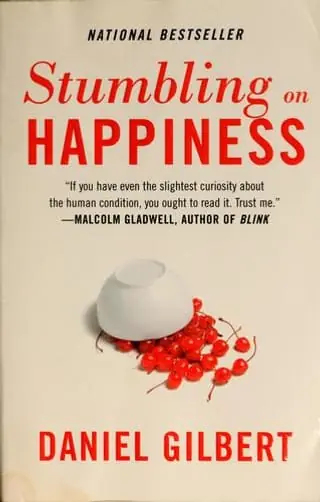
Stumbling on Happiness summary
by Daniel Gilbert · 2006 · 8 key ideas · 20-minute read
We're surprisingly bad at predicting what will make our future selves happy, because imagination quietly fills in, leaves out and colours the future with the present.
Why read it
For anyone making a big decision about a job, a move, a relationship or a purchase. It shows why your forecasts about your own feelings go wrong, and a simple fix.
Stumbling on Happiness in brief
Gilbert's book is not a how-to guide to happiness. It's an explanation of why we so often choose futures that don't make us as happy as we expected. Humans are perhaps the only animals that think much about the future, and we use that ability constantly to imagine how we'd feel in different situations. The trouble is that imagination has systematic flaws.
First, imagination fills in details we didn't really see and leaves out details that matter, without telling us it has done either. Second, it's tied to the present: we picture the future through the lens of how we feel right now. So our forecasts of future feelings often look suspiciously like our current ones.
Third, we fail to anticipate how well we'll cope. We have a psychological immune system that helps us find the silver lining in setbacks, but because it works out of sight, we overestimate how bad bad events will feel and for how long. Oddly, it works best when we're stuck with an outcome rather than able to undo it.
Gilbert also argues that happiness is subjective and hard to compare, whether across different people or across different moments in our own lives. Our memories of the past are reconstructed in the same way as our pictures of the future, so they are just as unreliable a guide to what will make us happy next time.
His solution is humbling but practical. Instead of imagining how a future will feel, ask someone who is living it now. Their report is often a better guide than our own imagination, even though we resist the idea because we think we're unique.
The 8 key ideas
1. We live in imagined futures
Your imagination is a trailer, not the film.
2. Happiness is hard to compare
You can't feel their feelings. Ask, don't assume.
3. The brain fills in the blanks
Vivid isn't the same as accurate.
4. Imagination leaves things out
Distant plans look simple. The details arrive later.
5. The present colours the future
Today's mood shouldn't sign tomorrow's contracts.
6. Your psychological immune system
You're tougher than your forecast.
7. Commitment helps you be content
Close the door and you'll love the room.
8. Ask someone who's already there
Don't imagine it. Ask someone living it.
Read the full guide in Kinquire. Every idea with a real example, a diagram and one thing to try today, plus a quick quiz so it sticks. Free to start.
Read Stumbling on HappinessKey takeaways
- Picture an ordinary day, not just highlights, when imagining a future.
- Don't make big decisions in strong moods; sleep on them.
- Expect to cope with setbacks better than you fear.
- Treat everyday choices as final once made.
- Before big decisions, ask people already living the option how they feel.
Our take
Stumbling on Happiness is witty, clear and grounded in Gilbert's own research on affective forecasting, which has held up well in broad terms. Its strengths are memorable experiments and a genuinely useful conclusion. Its limits: it explains why we mispredict but offers only one main remedy, and surrogation has practical hurdles (finding the right people, trusting their reports). Later research shows that adaptation is less complete for some events than the book's tone suggests, and that individual differences matter more than Gilbert sometimes implies. The jokes occasionally crowd the argument, but most readers find them part of the charm.
About Daniel Gilbert
Daniel Gilbert is a professor of psychology at Harvard University who studies how people predict their own emotional reactions. Stumbling on Happiness won the Royal Society's prize for science books.
If you liked this
- The Happiness Hypothesis by Jonathan Haidt
- Thinking, Fast and Slow by Daniel Kahneman
- The Paradox of Choice by Barry Schwartz
- Predictably Irrational by Dan Ariely
- Flow by Mihaly Csikszentmihalyi
- Emotional Intelligence by Daniel Goleman