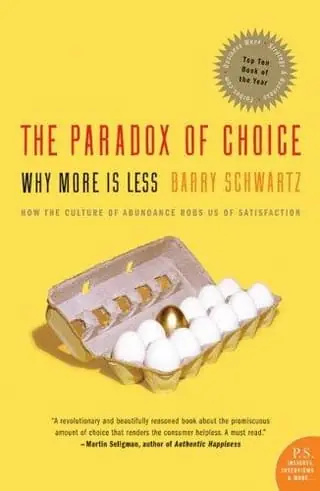
The Paradox of Choice summary
by Barry Schwartz · 2004 · 8 key ideas · 20-minute read
Some choice is good, but past a point more options make us more anxious, less decisive and less satisfied, especially if we insist on finding the very best.
Why read it
For anyone who feels worn out by endless options, from phone plans to dating apps. It explains why abundance can backfire and offers simple habits to choose more happily.
The Paradox of Choice in brief
Schwartz starts with a puzzle. Modern life in wealthy countries offers more choice than ever, in products, careers, relationships and lifestyles, yet people don't seem happier. He argues that while having some choice is essential for well-being, there is a point beyond which more choice starts to hurt.
Too many options can lead to paralysis, so that we put off deciding or don't decide at all. When we do choose, abundance raises our expectations, multiplies the attractive features we give up, and leaves us more open to regret. We become less satisfied with good outcomes because we can always imagine a better one.
The problem is worst for maximisers, people who feel they must find the very best option and keep searching until they are sure. Satisficers, who decide what 'good enough' means, look until they find it and then stop, tend to be happier with their choices, even when maximisers end up with objectively better ones.
Schwartz also explores adaptation, which makes the thrill of any choice fade; social comparison, which makes us measure our choices against others'; and self-blame, which grows when every outcome feels like our own responsibility. He links these to rising rates of depression in affluent societies.
He ends with practical advice for living well amid abundance: choose when to choose, satisfice more often, make decisions final, practise gratitude for what your choices give you, expect the thrill to fade, keep expectations modest, and learn to love the rules and constraints that spare you from deciding everything afresh.
The 8 key ideas
1. More choice, less satisfaction
Better options can still mean a worse feeling.
2. Too many options can freeze us
When choices pile up, decisions stall.
3. Maximisers vs satisficers
Good enough is often best.
4. Every choice has hidden costs
Each extra option is another thing to miss.
5. Regret grows with options
'If only' is the thief of good enough.
6. Adaptation and expectations
Expect less, enjoy more.
7. Comparison and self-blame
Compare less. Blame yourself less.
8. Learn to love constraints
Fewer choices, more freedom.
Read the full guide in Kinquire. Every idea with a real example, a diagram and one thing to try today, plus a quick quiz so it sticks. Free to start.
Read The Paradox of ChoiceKey takeaways
- Decide which choices matter and use rules or defaults for the rest.
- Set 'good enough' criteria before searching, and stop when they're met.
- Cap your shortlist at two or three options.
- Treat decisions as final and stop browsing alternatives.
- Expect the thrill of any purchase to fade, and keep expectations modest.
- Limit upward comparisons with others.
Our take
The Paradox of Choice gave people a language for a modern frustration, and its practical advice, especially about satisficing and making decisions final, is useful whatever the research says. But the headline claim has been challenged: meta-analyses suggest choice overload is not universal and depends heavily on context, and some original findings have been hard to replicate. Schwartz's link between choice and depression is speculative. The book also focuses on affluent consumers; for many people, too little choice is a bigger problem than too much. Read it as a thoughtful guide to choosing well, rather than a law of human nature.
About Barry Schwartz
Barry Schwartz is an American psychologist and professor emeritus of social theory and social action at Swarthmore College. His TED talk on the paradox of choice brought the book's ideas to a wide audience.
If you liked this
- Stumbling on Happiness by Daniel Gilbert
- Predictably Irrational by Dan Ariely
- Thinking, Fast and Slow by Daniel Kahneman
- The Happiness Hypothesis by Jonathan Haidt
- Flow by Mihaly Csikszentmihalyi
- Emotional Intelligence by Daniel Goleman