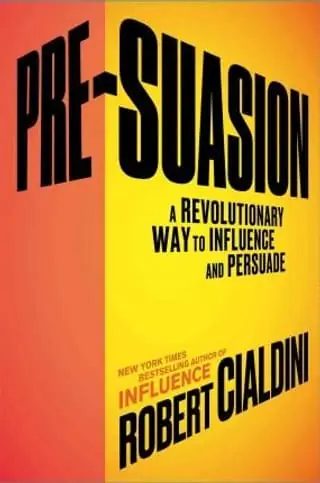
Pre-Suasion summary
by Robert B. Cialdini · 2016 · 7 key ideas · 18-minute read
The most effective persuaders win before they make their case, by steering the audience's attention to ideas that make them receptive to the message that follows.
Why read it
A sequel to Influence for anyone who presents, sells, writes or leads: it shifts the question from what to say to what to arrange just before you say it.
Pre-Suasion in brief
Cialdini noticed that the best persuaders he studied spent unusual effort on what happened before their request. They set up a moment in which the audience was already leaning their way. He calls this pre-suasion: arranging for people to be receptive to a message before they encounter it.
The engine is attention. Whatever we focus on in a given moment seems more important and more likely to be a cause. And once attention lands on a concept, related ideas become more accessible, quietly shaping the next judgment. So a well-chosen question, image, word or setting can tilt a decision before any argument begins.
Cialdini describes the features that grab attention automatically — the self-relevant, the unfinished, the mysterious — and how associations work, through language, metaphor and physical surroundings. He shows that the timing of a request matters, because a receptive state is often brief.
He then revisits his six principles of influence and adds a seventh: unity, the sense of shared identity created by being together or acting together. The book closes with an argument that pre-suasion must be used ethically, both because deception is wrong and because, in organisations, it backfires over time.
The 7 key ideas
1. Win the moment before the message
Persuasion starts before you speak.
2. Questions steer the answer
Whoever frames the question picks what you remember.
3. What's focal seems causal
The spotlight makes things look bigger than they are.
4. Magnets for attention
Open a loop, and they'll stay to close it.
5. Associations do quiet work
The room is part of the argument.
6. Unity: the seventh principle
People back what they helped build.
7. Pre-suade ethically — or pay later
If you can't explain the tactic, don't use it.
Read the full guide in Kinquire. Every idea with a real example, a diagram and one thing to try today, plus a quick quiz so it sticks. Free to start.
Read Pre-SuasionKey takeaways
- Plan the moment before your request, not just the request itself.
- Open with a question that brings relevant values or memories to mind.
- Put your strongest, truthful point at the centre of attention.
- Start talks and documents with a genuine mystery the content will solve.
- Ask for advice, not opinions, to turn others into co-authors.
- Use only cues that are relevant and true; skip anything you would hide.
Our take
Pre-Suasion offers a genuinely useful reframe — that timing and attention matter as much as arguments — and the unity principle is a thoughtful addition. It is more speculative than Influence, however. Many of the subtle priming effects it draws on come from a literature that has struggled with replication, and the book sometimes presents striking single studies with more confidence than the field now would. It also reads in places like a collection of findings rather than a tight argument. Read it for the mindset and the questions, and treat individual effect sizes with caution.
About Robert B. Cialdini
Robert Cialdini is a social psychologist, Regents' Professor Emeritus at Arizona State University, and the author of Influence. Pre-Suasion builds on that earlier work and adds a seventh principle, unity.
If you liked this
- Influence by Robert B. Cialdini
- Thinking, Fast and Slow by Daniel Kahneman
- Made to Stick by Chip Heath and Dan Heath
- Nudge by Richard H. Thaler and Cass R. Sunstein
- How to Win Friends and Influence People by Dale Carnegie
- Crucial Conversations by Kerry Patterson, Joseph Grenny, Ron McMillan and Al Switzler