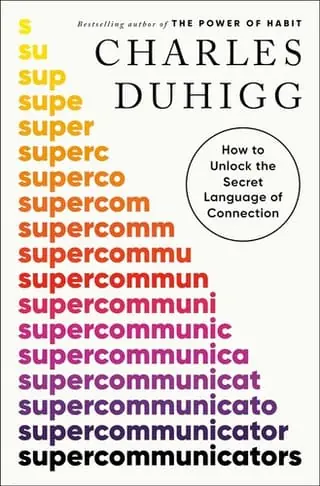
Supercommunicators summary
by Charles Duhigg · 2024 · 7 key ideas · 17-minute read
Every conversation is really one of three kinds — practical, emotional or social — and great communicators connect by noticing which one is happening and matching it.
Why read it
For anyone who has felt a conversation go sideways without knowing why. Duhigg blends research and stories into a clear map of how people actually connect.
Supercommunicators in brief
Duhigg asks why some people connect with almost anyone while others struggle, and finds the answer isn't charisma. 'Supercommunicators' pay unusually close attention to what kind of conversation is happening and adapt to it. Research on brain and body suggests that when people truly connect, their minds start to synchronise; the skills that create that alignment can be learned.
He argues that most discussions are really one of three conversations: a practical one about decisions and plans ('What's this really about?'), an emotional one about feelings ('How do we feel?'), or a social one about identities and relationships ('Who are we?'). Mismatches — offering solutions when someone wants empathy — are a common cause of miscommunication.
From this he draws four rules for a 'learning conversation': pay attention to which kind of conversation is happening, share your goals and ask what others want, ask about feelings and share your own, and explore whether identities matter in this discussion.
Duhigg then shows how to apply these ideas to hard cases: asking deeper questions, navigating conflict, discussing divisive topics and talking across differences. Throughout, his message is that connection comes from curiosity and from proving to others that we are truly listening.
The 7 key ideas
1. Three kinds of conversation
Match the conversation before you join it.
2. The matching principle
Meet them where they are.
3. Four rules for learning conversations
Kind, goals, feelings, identities.
4. Ask deeper questions
Ask about meaning, not just facts.
5. How do we feel?
Feelings first, fixes later.
6. Who are we?
Find the 'we' before the disagreement.
7. Prove you're listening
Don't say you heard them — show them.
Read the full guide in Kinquire. Every idea with a real example, a diagram and one thing to try today, plus a quick quiz so it sticks. Free to start.
Read SupercommunicatorsKey takeaways
- Ask yourself which kind of conversation is happening: practical, emotional or social.
- Match the other person's kind of talk before steering.
- Swap a fact question for a deeper question about meaning.
- When feelings appear, acknowledge before advising.
- Name shared identities in tense discussions.
- Loop: summarise their view and check you got it right.
Our take
Supercommunicators offers a clear, memorable framework and engaging stories, and its core advice — notice what kind of conversation you're in, ask deeper questions, prove you're listening — is practical and well grounded in established psychology. Its weaknesses are typical of narrative non-fiction: vivid stories can make findings feel more settled than they are, and some research it draws on, like neural synchrony, is still emerging. The three-conversation model is a useful simplification rather than a scientific taxonomy, and much of the advice echoes older works on listening and conflict. As an accessible synthesis, it is a strong introduction.
About Charles Duhigg
Charles Duhigg is a Pulitzer Prize-winning journalist and the author of The Power of Habit and Smarter Faster Better.
If you liked this
- How to Win Friends and Influence People by Dale Carnegie
- Crucial Conversations by Kerry Patterson, Joseph Grenny, Ron McMillan and Al Switzler
- Difficult Conversations by Douglas Stone, Bruce Patton and Sheila Heen
- The Power of Habit by Charles Duhigg
- Nonviolent Communication by Marshall B. Rosenberg
- The 5 Love Languages by Gary Chapman