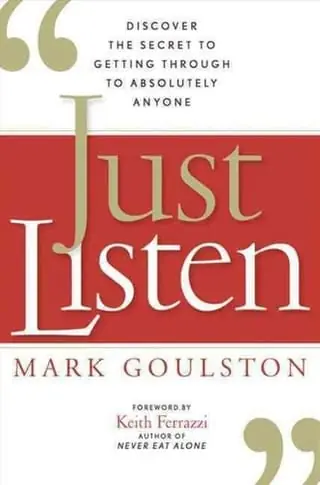
Just Listen summary
by Mark Goulston · 2009 · 7 key ideas · 17-minute read
You get through to people not by pushing harder but by calming yourself, making them feel deeply understood and letting them move themselves from resistance to agreement.
Why read it
For anyone who deals with defensive, angry or shut-down people — at work, at home or in sales. It's a psychiatrist's toolkit for lowering defences fast.
Just Listen in brief
Goulston begins with a simple observation: we rarely get through to people by arguing, pressuring or presenting better facts. Defensive, stressed people can't really hear us. To reach them, we first have to manage our own reactions and then help them feel understood, so they move from resisting to listening on their own.
He describes a 'persuasion cycle' that people move through: from resisting to listening, considering, being willing, doing, and finally being glad they did. Most failed attempts at persuasion try to jump straight from resistance to action. His techniques are designed to move people one step at a time.
The core rules are psychological rather than tactical. Calm your own threat response. Make the other person 'feel felt' by reflecting their emotions accurately. Be more interested than interesting. Make people feel valuable. Let them exhale their frustrations. Check how you're coming across, and be willing to show vulnerability.
The book closes with quick, practical tools for specific situations — such as the 'impossibility question' for unlocking stuck thinking, and powerful forms of thanks and apology — plus advice for difficult people and when to walk away. The thread through all of it is listening in a way that makes people feel truly heard.
The 7 key ideas
1. The persuasion cycle
Move them one step, not to the finish line.
2. Calm yourself first
Calm yourself before you try to calm them.
3. Make them feel felt
Don't say you understand — show it.
4. Be more interested than interesting
Fascinated beats fascinating.
5. Let them exhale
Let the steam out before you steer.
6. Check your own dissonance
You're judged by your impact, not your self-image.
7. Quick tools that open doors
Specific thanks, specific sorry — both land harder.
Read the full guide in Kinquire. Every idea with a real example, a diagram and one thing to try today, plus a quick quiz so it sticks. Free to start.
Read Just ListenKey takeaways
- Identify which stage of the persuasion cycle someone is in.
- Name your own emotion before you respond under pressure.
- Reflect people's feelings back and check you're right.
- Let upset people exhale before you try to fix anything.
- Ask trusted people how you come across.
- Give a power thank-you this week.
Our take
Just Listen is practical and humane, with techniques that are quick to learn and genuinely effective at lowering defences. Its focus on calming yourself and helping others feel understood is well supported by research on empathy and emotion regulation. Its weaknesses: it leans on popular neuroscience, like the 'three brains' model and mirror neurons, that experts now consider oversimplified; much of its evidence is anecdotal; and some tools can feel scripted if used mechanically. The persuasion framing also risks treating listening as a means to an end. Used sincerely, its listening advice remains valuable.
About Mark Goulston
Mark Goulston is an American psychiatrist and business coach. He has drawn on his clinical work, including with people in crisis, to teach communication and persuasion skills to businesses and other organisations.
If you liked this
- How to Win Friends and Influence People by Dale Carnegie
- Never Split the Difference by Chris Voss
- Supercommunicators by Charles Duhigg
- Nonviolent Communication by Marshall B. Rosenberg
- Crucial Conversations by Kerry Patterson, Joseph Grenny, Ron McMillan and Al Switzler
- The 5 Love Languages by Gary Chapman