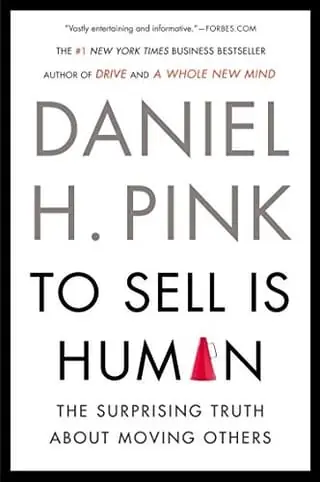
To Sell Is Human summary
by Daniel H. Pink · 2012 · 8 key ideas · 20-minute read
Almost everyone now spends their days moving others — persuading, convincing, influencing — and in a world of open information that works best through attunement, buoyancy and clarity rather than pressure.
Why read it
For anyone who thinks ‘I'm not in sales’: teachers, managers, doctors, parents. Pink shows you already sell every day and gives research-backed ways to do it honestly and well.
To Sell Is Human in brief
Pink opens by arguing that we are all in sales now. Only a minority of people hold traditional sales jobs, but most of us spend a large share of our working time on what he calls non-sales selling: persuading colleagues, pitching ideas, convincing students or patients. Selling is not a niche profession; it is a basic human activity.
Selling has also changed. For most of history the seller knew more than the buyer, so ‘buyer beware’ was sensible advice. With information now widely available, buyers can check everything, and the advantage shifts to sellers who are honest, direct and transparent.
Pink then replaces the old mantra ‘Always Be Closing’ with a new ABC: Attunement — understanding the other person's perspective; Buoyancy — staying afloat in an ocean of rejection; and Clarity — helping people see their situation in fresh, useful ways.
The final part covers what to do: pitch in new formats that invite participation, improvise by listening and accepting offers like an improv actor, and serve by making your efforts personal and purposeful. The deepest form of selling, he concludes, is to leave the other person better off.
The 8 key ideas
1. We're all in sales now
If you persuade, you sell.
2. From buyer beware to seller beware
Assume they can check — because they can.
3. Attunement: lower your power, take their view
Step down to see further.
4. Ambiverts sell best
Talk enough to lead, listen enough to understand.
5. Buoyancy: before, during and after
Ask yourself a question; explain the no as a moment.
6. Clarity: find the right problem and frame it
Fewer options, clearer frame, one next step.
7. Pitch beyond the elevator
Don't tell them — ask them, or tell a story.
8. Serve: make it personal and purposeful
Will they be better off? Then sell it.
Read the full guide in Kinquire. Every idea with a real example, a diagram and one thing to try today, plus a quick quiz so it sticks. Free to start.
Read To Sell Is HumanKey takeaways
- Notice how much of your day is spent moving people, and treat it as a skill.
- Assume others can check your claims; lead with honesty and your weak points.
- Before persuading, write out the other person's perspective.
- Ask ‘Can I…?’ before a challenge and explain rejections as temporary.
- Offer fewer, clearer options and a specific next step.
- Connect your pitch to the person it helps and the purpose it serves.
Our take
To Sell Is Human is readable, warm and full of research-based tools, and its central reframe — that persuasion is a universal skill — is persuasive. Its weaknesses are typical of popular social science: it leans on single studies, some of which (like the positivity ratio) have since been challenged; it can feel like a tour of interesting findings rather than a deep method; and professional salespeople may find it light on the hard mechanics of closing deals. As a guide to persuading honestly in everyday life, it holds up well.
About Daniel H. Pink
Daniel Pink is an American author of several bestselling books on work and behaviour, including Drive and A Whole New Mind. He previously worked as a speechwriter, including for US Vice President Al Gore.
If you liked this
- Drive by Daniel H. Pink
- Influence by Robert B. Cialdini
- The Challenger Sale by Matthew Dixon and Brent Adamson
- How to Win Friends and Influence People by Dale Carnegie
- Crucial Conversations by Kerry Patterson, Joseph Grenny, Ron McMillan and Al Switzler
- Nonviolent Communication by Marshall B. Rosenberg