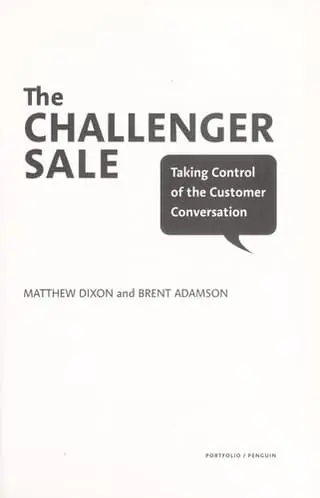
The Challenger Sale summary
by Matthew Dixon and Brent Adamson · 2011 · 8 key ideas · 19-minute read
In complex B2B sales, the best performers don't just build relationships — they teach customers something new about their business, tailor it to each stakeholder and take control of the conversation.
Why read it
For B2B salespeople, sales leaders and founders selling complex solutions. It challenges the comfortable belief that being liked and responsive is what wins deals.
The Challenger Sale in brief
The book starts from research by CEB's Sales Executive Council into what separates high-performing B2B salespeople from average ones. Studying thousands of reps across many companies, the authors grouped them into five profiles: the Hard Worker, the Relationship Builder, the Lone Wolf, the Reactive Problem Solver and the Challenger.
Challengers were heavily over-represented among star performers, especially in complex sales, while Relationship Builders — whom many managers would bet on — were the least likely to be stars. Challengers have a deep understanding of the customer's business and use it to push the customer's thinking and teach them something new.
The authors summarise the Challenger's approach in three moves: teach, tailor and take control. They teach customers commercial insights that reframe how they see their business and lead back to the supplier's unique strengths. They tailor that message to the priorities of each stakeholder. And they are comfortable discussing money and pushing back, maintaining constructive tension rather than giving in.
Finally, they argue that Challenger selling is not just an individual talent. Organisations can build it, by having marketing develop teachable insights, training reps to deliver them, and equipping sales managers to coach — because the manager is where change in sales behaviour sticks or fails.
The 8 key ideas
1. Five kinds of salesperson
Stars don't just serve customers — they stretch them.
2. Being liked isn't enough
Earn the relationship; don't buy it with discounts.
3. Loyalty comes from how you sell
Make customers smarter and they'll stay.
4. Teach with a reframe
Teach them something new that only you can solve.
5. The teaching choreography
Their world first, your product last.
6. Tailor to each stakeholder
One insight, many audiences.
7. Take control — assertively
Be assertive about value, never aggressive with people.
8. Managers make Challengers
Insights come from the company; courage comes from coaching.
Read the full guide in Kinquire. Every idea with a real example, a diagram and one thing to try today, plus a quick quiz so it sticks. Free to start.
Read The Challenger SaleKey takeaways
- Build one commercial insight that challenges a customer belief and leads to your strengths.
- Structure pitches from the customer's world to your solution, product last.
- Tailor each conversation to how the individual stakeholder is measured.
- Talk about money directly and trade, don't give, concessions.
- Judge yourself by what customers learn from you, not just how much they like you.
- Managers: coach real conversations, not just pipelines.
Our take
The Challenger Sale gave B2B sales a fresh, research-based vocabulary and a useful shift from serving customers to helping them think. Its data on loyalty and rep profiles is striking. But the research is correlational and based partly on manager ratings, so it can't prove that becoming a Challenger causes success. The profiles risk being applied like personality labels, and ‘challenging’ can be misread as arrogance. It also has less to say about simple, transactional sales. CEB later published The Challenger Customer, focusing on how buying groups decide.
About Matthew Dixon and Brent Adamson
Matthew Dixon and Brent Adamson were leaders at the research and advisory firm CEB (the Corporate Executive Board), where the book's research on sales performance was carried out.
If you liked this
- SPIN Selling by Neil Rackham
- To Sell Is Human by Daniel H. Pink
- Fanatical Prospecting by Jeb Blount
- How to Win Friends and Influence People by Dale Carnegie
- Crucial Conversations by Kerry Patterson, Joseph Grenny, Ron McMillan and Al Switzler
- Nonviolent Communication by Marshall B. Rosenberg