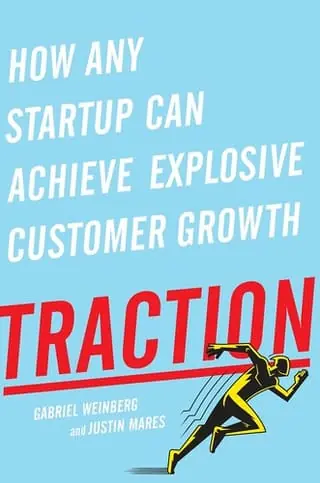
Traction summary
by Gabriel Weinberg and Justin Mares · 2015 · 7 key ideas · 18-minute read
Most startups fail from a lack of customers, not a lack of product, so test many traction channels early and focus hard on the one that works.
Why read it
For founders and early marketers who know how to build but not how to grow. It gives a map of every main way to find customers and a simple framework for choosing among them.
Traction in brief
Weinberg and Mares start from a blunt observation: founders tend to obsess over building the product and treat finding customers as an afterthought. Yet almost every startup that fails, they argue, fails because it cannot get enough traction, meaning real evidence of customer demand and growth.
Drawing on interviews with dozens of founders, they describe nineteen traction channels, from search engine optimisation and content marketing to trade shows, sales teams and engineering as marketing. Founders tend to consider only the few they already know, and those are often the most crowded.
Their main tool is the Bullseye framework. Brainstorm ideas for every channel, rank them, choose the most promising three, run cheap tests, and focus on the one that works. Because one channel usually dominates growth at any given stage, finding it matters more than doing many things moderately well.
They also suggest spending about half your time on traction from the start, in parallel with product work, and setting a clear traction goal that defines what matters now. The rest of the book walks through each channel with practical tactics and examples.
The 7 key ideas
1. Traction is half the work
If you build it, they won't automatically come.
2. Consider every channel
The quiet channel may be the profitable one.
3. The Bullseye framework
Test three, keep one.
4. Test to answer three questions
Cheap sign-ups can be expensive customers.
5. Engineering as marketing
Give them a tool and they'll find your product.
6. Unconventional PR
Be remarkable enough to be remarked upon.
7. Set a traction goal
If it isn't on the critical path, it can wait.
Read the full guide in Kinquire. Every idea with a real example, a diagram and one thing to try today, plus a quick quiz so it sticks. Free to start.
Read TractionKey takeaways
- Spend a real share of your time on getting customers from the very start.
- Brainstorm ideas for all nineteen channels before choosing where to focus.
- Run cheap tests on three channels and compare cost, volume and customer quality.
- Focus on the one channel that clearly works rather than doing many half-heartedly.
- Consider building a free tool your customers would value.
- Set one traction goal and cut work that isn't on the path to it.
Our take
Traction remains one of the most practical books on early-stage marketing: the Bullseye framework is simple, and the channel-by-channel tour is a handy reference. Its main weakness is age. Some tactics and examples date from before today's crowded social and ad platforms, and costs and norms have shifted. The book is also stronger on breadth than depth; each channel gets a brisk chapter, not a complete playbook. It focuses mainly on tech startups, so a local service business may find parts less relevant. As a way to think systematically about finding customers, it holds up well.
About Gabriel Weinberg and Justin Mares
Gabriel Weinberg founded the privacy-focused search engine DuckDuckGo and is its CEO. Justin Mares is an entrepreneur who has started several companies.
If you liked this
- $100M Leads by Alex Hormozi
- Zero to One by Peter Thiel with Blake Masters
- The Lean Startup by Eric Ries
- The Hard Thing About Hard Things by Ben Horowitz
- The E-Myth Revisited by Michael E. Gerber
- $100M Offers by Alex Hormozi