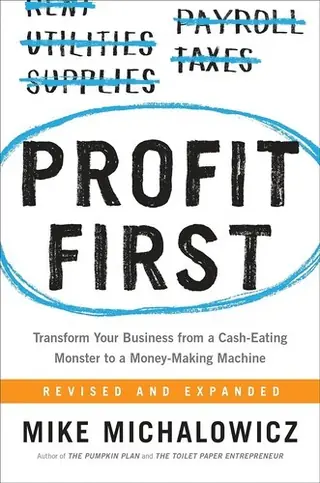
Profit First summary
by Mike Michalowicz · 2014 · 7 key ideas · 18-minute read
Small businesses stay broke because profit is whatever is left over, so take your profit first and run the business on what remains.
Why read it
For owners of small businesses and freelancers who bring in decent revenue yet never seem to have money left. It offers a simple cash system that works with human nature instead of against it.
Profit First in brief
Michalowicz starts from a frustrating pattern: businesses that grow revenue yet stay cash-starved, with owners working hard and paying themselves last. The traditional formula, sales minus expenses equals profit, treats profit as a leftover. Because spending tends to rise to match whatever money is available, there is rarely anything left.
His fix is to flip the formula: sales minus profit equals expenses. Every time money comes in, a set percentage goes straight to profit, owner's pay and tax before anything is spent. The business then has to operate on the remainder, which forces leaner, more creative spending.
The system works through separate bank accounts: one for income, then accounts for profit, owner's pay, tax and operating expenses. Twice a month, all income is split between them by fixed percentages. Profit and tax accounts sit at a different bank to remove temptation. Each quarter, owners take half the profit account as a reward.
Start where you are, with small percentages, and increase them each quarter towards healthier targets. Along the way, cut costs that don't earn their keep. The underlying idea is behavioural: rather than relying on willpower, design your money system so the right outcome happens automatically.
The 7 key ideas
1. Flip the formula
Take profit first, or there won't be any.
2. Work with human nature
Out of sight, out of spending.
3. Five foundational accounts
Give every pound a job before you spend it.
4. Remove the temptation
If it's easy to take, it'll get taken.
5. Start small, then raise the bar
Start with 1%. Just start.
6. Find the rhythm
A steady rhythm beats a cash panic.
7. Make expenses earn their place
If it doesn't earn or save, it goes.
Read the full guide in Kinquire. Every idea with a real example, a diagram and one thing to try today, plus a quick quiz so it sticks. Free to start.
Read Profit FirstKey takeaways
- Take a small percentage of every payment as profit before paying any bills.
- Set up separate accounts for profit, owner's pay, tax and expenses.
- Keep profit and tax money at a separate bank to remove temptation.
- Allocate income on a fixed rhythm, such as the 10th and 25th.
- Take half the profit account as a reward each quarter and keep the rest as a reserve.
- Review every expense and cut what doesn't earn or save.
Our take
Profit First is popular because it is simple and works with human psychology rather than against it; many owners report that separate accounts and taking profit first finally gave them control of cash. Its limits are practical. Some accountants note it is a cash-management system, not a replacement for proper accounting, forecasting or investment decisions. Businesses with lumpy income, heavy upfront costs or ambitious growth plans may find fixed percentages too rigid. The many accounts add admin. Used as a discipline rather than a rulebook, it remains a strong tool for small, cash-strapped businesses.
About Mike Michalowicz
Mike Michalowicz is an American entrepreneur and author who has founded and sold businesses. His other books include The Pumpkin Plan and Clockwork.
If you liked this
- The E-Myth Revisited by Michael E. Gerber
- Nudge by Richard H. Thaler and Cass R. Sunstein
- Company of One by Paul Jarvis
- Zero to One by Peter Thiel with Blake Masters
- The Lean Startup by Eric Ries
- The Hard Thing About Hard Things by Ben Horowitz