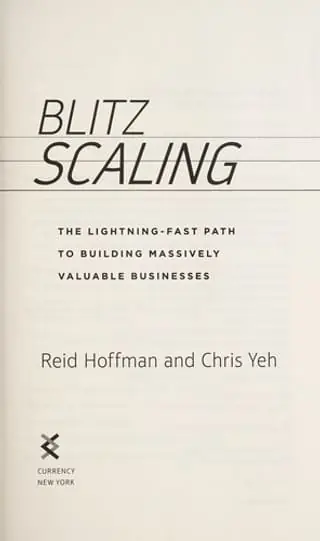
Blitzscaling summary
by Reid Hoffman and Chris Yeh · 2018 · 7 key ideas · 18-minute read
In winner-take-most markets, the company that deliberately trades efficiency for speed and scales first, despite the chaos, is the one that wins.
Why read it
For founders, investors and leaders of fast-growing companies who want to understand how today's tech giants grew so quickly, and when that approach is wise or reckless.
Blitzscaling in brief
Hoffman and Yeh define blitzscaling as prioritising speed over efficiency in an environment of uncertainty. It means growing so fast that you knowingly accept waste, risk and chaos, because in some markets getting big first is worth far more than getting big carefully.
It makes sense only in certain conditions. When markets have strong network effects or other winner-take-most dynamics, the first company to reach scale can lock in a lasting lead. The authors call this first-scaler advantage, and they argue it matters more than being first to market.
Before blitzscaling, a company needs the right business model: a large market, good distribution, high gross margins and network effects, with no major limits on product-market fit or operational scalability. As it grows, it passes through stages from family to tribe, village, city and nation, and management must change at each.
Blitzscaling requires counterintuitive choices: launch before you're comfortable, let small fires burn, and raise more money than seems necessary. The authors close by urging responsible blitzscaling and knowing when to stop, since speed can also magnify harm to employees, users and society.
The 7 key ideas
1. Speed over efficiency
Sometimes fast and messy beats slow and perfect.
2. First-scaler advantage
It's not who starts first. It's who scales first.
3. Design the business model first
Speed amplifies your model, flaws included.
4. Family, tribe, village, city, nation
What got you to tribe won't get you to city.
5. Launch before you're ready
If it doesn't embarrass you, you shipped too late.
6. Let fires burn
Fight the fires that can burn the house down.
7. Blitzscale responsibly
Scale magnifies everything, including your mistakes.
Read the full guide in Kinquire. Every idea with a real example, a diagram and one thing to try today, plus a quick quiz so it sticks. Free to start.
Read BlitzscalingKey takeaways
- Check whether your market is truly winner-take-most before trading efficiency for speed.
- Assess your model on market size, distribution, gross margins and network effects.
- Plan for how management must change as you move from tribe to village to city.
- Launch earlier than feels comfortable when speed really matters.
- Fight only the problems that threaten the company and let small fires burn.
- Identify serious potential harms early and build safeguards.
Our take
Blitzscaling clearly explains how many of the largest tech companies grew, and its frameworks, such as growth factors and the five stages, are useful even for companies that never blitzscale. Its weaknesses have become more visible over time. The book relies heavily on success stories, especially companies Hoffman invested in, and gives limited attention to the many that burned huge sums and failed. Cheap capital made the strategy look easier than it is. Critics argue it encouraged growth at all costs. Read it to understand a powerful but risky playbook and when it actually applies.
About Reid Hoffman and Chris Yeh
Reid Hoffman co-founded LinkedIn and is a partner at the venture capital firm Greylock. Chris Yeh is an entrepreneur and writer who also co-authored The Alliance with Hoffman.
If you liked this
- Zero to One by Peter Thiel with Blake Masters
- The Hard Thing About Hard Things by Ben Horowitz
- The Lean Startup by Eric Ries
- The E-Myth Revisited by Michael E. Gerber
- $100M Offers by Alex Hormozi
- $100M Leads by Alex Hormozi