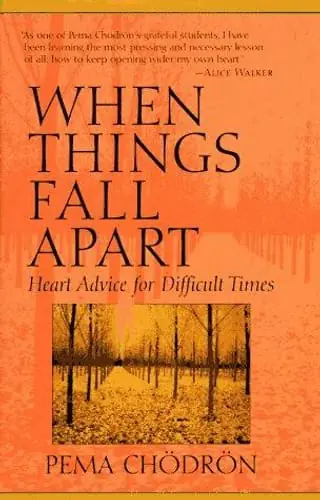
When Things Fall Apart summary
by Pema Chödrön · 1996 · 8 key ideas · 20-minute read
When life collapses, the urge is to escape; this Buddhist teacher argues that staying with the pain and uncertainty — with gentleness toward yourself — is the path to courage and an open heart.
Why read it
For anyone going through loss, a breakup, illness or upheaval who wants wise, compassionate guidance on how to sit with difficulty rather than run from it.
When Things Fall Apart in brief
The book is a collection of short teachings, many given as talks at Gampo Abbey. Its premise is simple and counter-intuitive: when things fall apart, it is not necessarily a disaster. It can be a kind of testing and a kind of healing — an opportunity to see our habits clearly and to open up.
Chödrön observes that most of us spend our lives trying to avoid discomfort and find solid ground. We grasp at pleasure, flee pain, and look for security in plans, relationships and opinions. But life is fundamentally uncertain, and our struggle against that fact causes much of our suffering.
Her alternative is to stay — to lean into the experience of groundlessness with curiosity rather than panic. That requires maitri, an unconditional friendliness toward ourselves, so that we can face fear and pain without self-hatred. It also requires letting go of hope as an escape from the present.
She offers practical tools from Tibetan Buddhism: meditation, tonglen (breathing in pain and breathing out relief), and teachings like the eight worldly concerns and the three methods for working with chaos. Each helps turn difficult emotions from enemies into teachers.
Throughout, she emphasises gentleness and humour. The path is not about becoming perfect or invulnerable, but about developing the courage to be fully present to life — including its pain — and, from that place, to open our hearts to others who are suffering.
The 8 key ideas
1. Falling apart as an opening
Falling apart is also falling open.
2. Get intimate with fear
Bravery is knowing fear well.
3. Maitri: friendliness to yourself
Be on your own side.
4. Give up hope
Drop the hope of escape; arrive.
5. The eight worldly concerns
Praise and blame are weather, not identity.
6. Tonglen: breathe in the pain
Breathe in what hurts, breathe out what heals.
7. Three ways to work with chaos
Stop the fight, use the poison, learn from it.
8. Cool loneliness
Stay with the empty room until it's spacious.
Read the full guide in Kinquire. Every idea with a real example, a diagram and one thing to try today, plus a quick quiz so it sticks. Free to start.
Read When Things Fall ApartKey takeaways
- When life falls apart, ask what it is showing you about your habits.
- Spend a few minutes each day feeling fear or discomfort in the body without escaping.
- Speak to yourself as a kind friend would, especially in hard moments.
- Notice the eight worldly concerns as they pull at you.
- Practise tonglen when you're in pain, including everyone who feels the same.
- Sit with loneliness occasionally rather than filling every silence.
Our take
When Things Fall Apart is one of the most compassionate guides to hard times in any tradition, and its core teaching — that we suffer more by fleeing pain than by facing it — fits well with modern exposure-based and acceptance-based therapies. Its short chapters can be read one at a time when life is difficult. Its limits: it assumes some interest in Buddhist practice, and teachings like 'regard whatever arises as wisdom' can feel abstract or even troubling without a teacher. Its message of staying with pain needs balancing with practical action and, sometimes, professional help. Some readers also find the chapters repetitive.
About Pema Chödrön
Pema Chödrön is an American Buddhist nun in the Tibetan tradition and a student of Chögyam Trungpa. She has long been associated with Gampo Abbey, a monastery in Nova Scotia, Canada, where she has been resident teacher.
If you liked this
- Radical Acceptance by Tara Brach
- The Miracle of Mindfulness by Thich Nhat Hanh
- Man's Search for Meaning by Viktor E. Frankl
- Meditations by Marcus Aurelius
- Letters from a Stoic by Seneca
- The Enchiridion by Epictetus