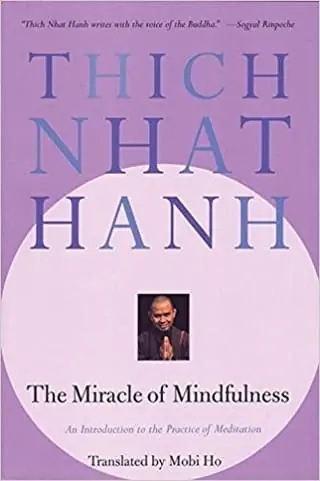
The Miracle of Mindfulness summary
by Thich Nhat Hanh · 1975 · 7 key ideas · 17-minute read
Mindfulness is not something you do on a cushion but a way of living each ordinary moment — washing dishes, eating, breathing — fully awake.
Why read it
For anyone who wants a gentle, practical guide to meditation in daily life, written with unusual warmth and simplicity by one of the best-loved teachers of the twentieth century.
The Miracle of Mindfulness in brief
The book began as a long letter Thich Nhat Hanh wrote in the mid-1970s to Brother Quang, a colleague in the School of Youth for Social Service, which trained young people for relief work during the Vietnam War. Its practical purpose was to help exhausted volunteers stay grounded while working in difficult conditions.
His message is that mindfulness — keeping your consciousness alive to the present reality — should be practised all day, not just during formal meditation. Washing dishes, drinking tea or walking can each be a meditation, if done with full awareness. The real miracle, he suggests, is not walking on water but walking on the earth, awake.
The breath is the main tool. Conscious breathing joins body and mind, and can be practised anywhere. He offers simple methods: following each breath, counting breaths, and smiling gently to relax. He also recommends a weekly 'day of mindfulness' to strengthen the habit.
In later chapters he moves from attention to insight. Looking deeply, we see that nothing exists separately: the self is made of changing parts, and our lives are woven together with others. This understanding naturally leads to compassion. Compassion, in this view, is not an extra virtue but the natural fruit of seeing clearly.
He closes with Tolstoy's story of the emperor's three questions, which sums up the whole book: the most important time is now, the most important person is the one you're with, and the most important task is to do good for them. Exercises at the end help readers put it all into practice.
The 7 key ideas
1. Wash the dishes to wash the dishes
Don't rush the dishes to reach the tea.
2. All time is your time
Present for it, and every hour is yours.
3. Eat the tangerine
Eat the segment in your hand.
4. The breath as a bridge
Breathe in, I know I'm here.
5. A day of mindfulness
One slow day sweetens six fast ones.
6. Looking deeply: interdependence
Look deeply, and the enemy becomes a person.
7. The three questions
Now, this person, their good.
Read the full guide in Kinquire. Every idea with a real example, a diagram and one thing to try today, plus a quick quiz so it sticks. Free to start.
Read The Miracle of MindfulnessKey takeaways
- Do one routine task each day fully, for its own sake.
- Stop splitting your day into 'mine' and 'theirs' — be present for each part.
- Eat the first bites of one meal a day in silence and attention.
- Use your breath, counting and a half-smile as anchors throughout the day.
- Protect a weekly half-day of slow, screen-free living.
- In each conversation, treat the person in front of you as the most important one.
Our take
The Miracle of Mindfulness is short, kind and immediately usable; its examples, like washing dishes and eating a tangerine, have become classics because they work. It helped bring mindfulness to the West long before it was fashionable, and its emphasis on everyday practice rather than special experiences remains wise. Its limitations: it is written from within a Buddhist framework, and the later sections on the five aggregates and interdependence may feel abstract to secular readers. It offers little on the difficulties of practice or on cases where meditation is not enough, such as serious mental illness. Translations also vary in tone.
About Thich Nhat Hanh
Thich Nhat Hanh (1926–2022) was a Vietnamese Zen Buddhist monk, peace activist and founder of the Plum Village community in France. Martin Luther King Jr. nominated him for the Nobel Peace Prize in 1967.
If you liked this
- Wherever You Go, There You Are by Jon Kabat-Zinn
- When Things Fall Apart by Pema Chödrön
- Meditations by Marcus Aurelius
- Letters from a Stoic by Seneca
- The Enchiridion by Epictetus
- The Obstacle Is the Way by Ryan Holiday