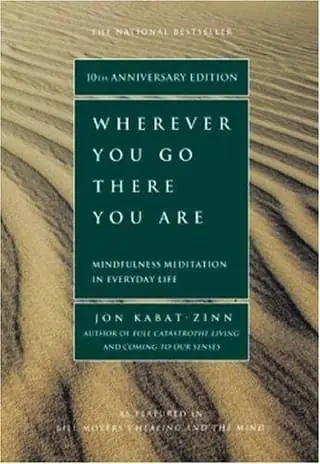
Wherever You Go, There You Are summary
by Jon Kabat-Zinn · 1994 · 7 key ideas · 18-minute read
Mindfulness — paying attention on purpose, in the present moment, without judgment — is a simple, secular practice that lets you actually live the moments of your life instead of rushing past them.
Why read it
For anyone curious about meditation who wants a gentle, non-religious introduction from the person who brought mindfulness into Western medicine.
Wherever You Go, There You Are in brief
Kabat-Zinn wrote this book as a companion for ordinary people, not monks or patients. It is made of many short chapters, each exploring one aspect of mindfulness and ending with a suggestion to try. You can dip in anywhere. It reads more like a set of reflections than a manual.
His core definition: mindfulness means paying attention in a particular way — on purpose, in the present moment, and non-judgmentally. It sounds simple, but most of our lives are lived on autopilot, lost in thought about the past and future. We miss the only moments we actually have.
The first part describes the attitudes behind practice: non-doing, patience, letting go, non-judging, trust, generosity and simplicity. The second part covers formal practices — sitting, walking, standing and lying down, as well as imagery like the mountain and lake meditations. The third part brings mindfulness into everyday life, including work and parenting.
Running through the book is the title's insight. We often think a new place, job or relationship will fix us, but we bring our minds with us. Wherever you go, there you are. Real change starts with how you meet this moment, here.
Kabat-Zinn stresses that meditation is not about achieving a special state or getting anywhere. It is about being fully present with whatever is happening, pleasant or not. That simple shift, practised over time, can change how we relate to stress, pain and our own lives.
The 7 key ideas
1. Three parts of mindfulness
On purpose, right now, without a verdict.
2. You take yourself with you
Your mind always travels with you.
3. Non-doing
Nothing happens next. This is it.
4. Learn to surf
You can't stop the waves — learn to surf.
5. Formal and informal practice
Train on the cushion; play it out in life.
6. Be the mountain
Weather passes; the mountain stays.
7. Patience and letting go
Every return to now is the practice.
Read the full guide in Kinquire. Every idea with a real example, a diagram and one thing to try today, plus a quick quiz so it sticks. Free to start.
Read Wherever You Go, There You AreKey takeaways
- Practise attention that is on purpose, present and non-judging, starting with one routine activity.
- Before seeking a new place or job to fix you, notice which habits would follow you.
- Sit for five minutes a day with no goal except to be present.
- Meet stress and pain with curiosity rather than resistance.
- Combine short formal sessions with informal mindful moments during the day.
- Treat each return from mind-wandering as a success.
Our take
This is one of the most influential introductions to mindfulness ever written, and its secular, gentle approach helped make meditation mainstream. Its short chapters are easy to dip into and its practices are well tested in MBSR. Weaknesses: the style can feel loose and repetitive, with more inspiration than structure, so beginners wanting a step-by-step programme may prefer Kabat-Zinn's Full Catastrophe Living. Research since has found real but moderate benefits for mindfulness programmes, and growing awareness that meditation can occasionally bring up difficult experiences — something the book only briefly addresses.
About Jon Kabat-Zinn
Jon Kabat-Zinn trained as a molecular biologist at MIT and in 1979 founded the Stress Reduction Clinic at the University of Massachusetts Medical School, where he developed Mindfulness-Based Stress Reduction (MBSR).
If you liked this
- The Miracle of Mindfulness by Thich Nhat Hanh
- 10% Happier by Dan Harris
- The Power of Now by Eckhart Tolle
- Meditations by Marcus Aurelius
- Letters from a Stoic by Seneca
- The Enchiridion by Epictetus