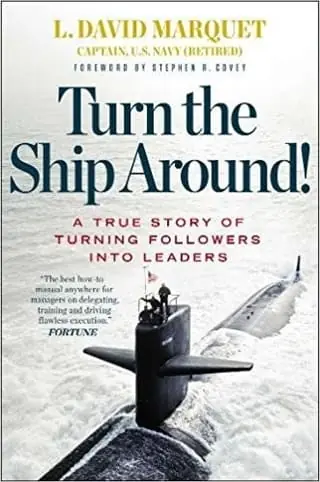
Turn the Ship Around! summary
by L. David Marquet · 2012 · 7 key ideas · 18-minute read
A submarine captain discovers that giving orders creates followers, and that pushing control down — with competence and clarity — turns a struggling crew into a team of leaders.
Why read it
For any leader who feels the whole operation depends on them. It's a gripping true story with concrete, transferable practices for giving people real ownership, even in the strictest environments.
Turn the Ship Around! in brief
Marquet spent a year preparing to command one submarine, then was abruptly assigned to a different one: the USS Santa Fe, which had a poor reputation for performance and morale. He knew little about its specific equipment. On a ship where the captain is expected to know everything, he couldn't — and that forced a rethink.
Early on, he gave an order the ship couldn't carry out, and a junior officer relayed it anyway. Marquet realised the traditional ‘leader-follower’ model had a fatal flaw: people would follow orders even when they knew they were wrong. He set out to build a ‘leader-leader’ model where people at every level think, decide and take responsibility.
The book describes dozens of practical mechanisms, grouped into three pillars. Control: push decision-making authority down, using language like ‘I intend to…’. Competence: make sure people have the technical knowledge to use that authority well. Clarity: make sure everyone understands the goals and principles behind the decisions.
Each short chapter tells a story from the Santa Fe and ends with questions for readers' own organisations. Marquet reports that the ship went from among the worst performers to among the best, and stayed strong after he left — the real test, he argues, of whether leadership has been built into the organisation rather than resting on one person.
The 7 key ideas
1. Leader-leader, not leader-follower
Don't create followers; create leaders.
2. Say ‘I intend to…’
Swap ‘May I?’ for ‘I intend to’.
3. Move authority to the information
Decide where the information lives.
4. Control needs competence
Don't tell them — have them show they know.
5. Control needs clarity
Give control only as fast as you give clarity.
6. Resist the urge to solve
Every answer you give is a thought they didn't have.
7. Build it to outlast you
Lead so you won't be needed.
Read the full guide in Kinquire. Every idea with a real example, a diagram and one thing to try today, plus a quick quiz so it sticks. Free to start.
Read Turn the Ship Around!Key takeaways
- Replace requests for permission with ‘I intend to…’ statements.
- Move decisions to the people who have the best information.
- Certify understanding instead of giving one-way briefings.
- Write a few guiding principles so people can decide consistently.
- Ask questions before offering answers.
- Judge your leadership by how the team would perform without you.
Our take
Turn the Ship Around! is one of the most practical leadership books available, with concrete mechanisms that readers can try immediately. Its submarine setting makes the lessons more credible: if empowerment works there, it can work almost anywhere. Its limits: the evidence is mainly one leader's account of one ship, so other factors — a strong crew, Navy support — are hard to separate out. Some mechanisms rely on highly trained, motivated people, and the book says less about handling those who don't want more responsibility. Still, it has influenced many leaders and its core principles fit broader research on empowerment.
About L. David Marquet
L. David Marquet is a retired US Navy captain who commanded the nuclear-powered attack submarine USS Santa Fe. After leaving the Navy he became a writer and speaker on leadership.
If you liked this
- Extreme Ownership by Jocko Willink and Leif Babin
- Team of Teams by Stanley McChrystal
- Multipliers by Liz Wiseman
- Good to Great by Jim Collins
- Built to Last by Jim Collins and Jerry I. Porras
- The Innovator's Dilemma by Clayton M. Christensen