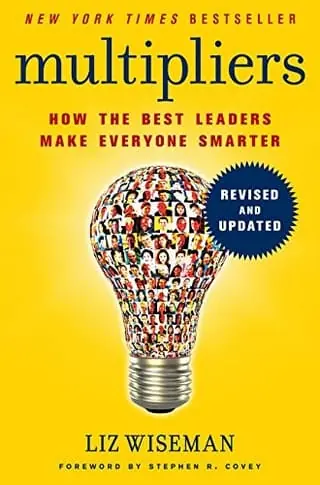
Multipliers summary
by Liz Wiseman · 2010 · 7 key ideas · 17-minute read
Some leaders make everyone around them smarter and more capable, while others drain people's intelligence — and the difference comes down to five learnable disciplines.
Why read it
For managers and experts who are used to being the smartest person in the room. It shows how to get far more out of a team by using people's intelligence instead of replacing it.
Multipliers in brief
Wiseman noticed during her years at Oracle that some leaders seemed to make everyone around them sharper, while others, equally brilliant, left people feeling small and hesitant. With colleagues she studied leaders across many companies and countries, comparing those people described as ‘Multipliers’ with those described as ‘Diminishers’.
Her central finding is that Multipliers get far more from the same people. In her research, people said they gave Multipliers roughly twice as much of their capability as they gave Diminishers. The difference wasn't talent or effort, but how leaders used the intelligence around them.
She identifies five disciplines that separate them. Multipliers attract and fully use talent, create an intense but safe environment, set stretching challenges, drive decisions through rigorous debate, and give people real ownership. Diminishers do the opposite: they hoard talent, create anxiety, give directions, decide alone, and micromanage.
Underneath the behaviours is a belief. Multipliers assume people are smart and will figure things out; Diminishers assume people won't manage without them. A later edition added a warning that many Diminishers are ‘accidental’ — well-meaning leaders whose helpfulness quietly shuts others down.
The 7 key ideas
1. Multipliers vs Diminishers
Be a genius-maker, not a genius.
2. It starts with a belief
What you believe about people, they become.
3. Talent Magnet, not Empire Builder
Find what people do easily, and let them do more of it.
4. Liberator, not Tyrant
Safe to think, expected to excel.
5. Challenger, not Know-It-All
Ask the question that stretches the room.
6. Debate Maker, not Decision Maker
Debate widely, then decide clearly.
7. Investor, not Micromanager
Help, then hand it back.
Read the full guide in Kinquire. Every idea with a real example, a diagram and one thing to try today, plus a quick quiz so it sticks. Free to start.
Read MultipliersKey takeaways
- Notice whether people leave your meetings having done more thinking or less.
- Name each person's ‘native genius’ and give them work that uses it.
- Speak last in meetings and treat mistakes as learning.
- Turn instructions into stretching questions.
- When someone brings a problem, coach them and give it back.
Our take
Multipliers gives leaders a sharp, memorable mirror: the five disciplines and their opposites make it easy to spot your own diminishing habits. Its research is largely based on interviews and people's ratings of leaders they've worked with, so the headline numbers are perceptions rather than hard measurements, and the neat Multiplier/Diminisher split simplifies real behaviour. It also says less about situations where a leader genuinely needs to decide fast or where team members lack experience. The later edition's ‘accidental Diminisher’ chapter is one of its most practical additions. Overall, its core message fits well with broader research on empowerment.
About Liz Wiseman
Liz Wiseman spent many years as an executive at Oracle, including running its internal corporate university, before founding a leadership research and development firm. Multipliers was written with Greg McKeown.
If you liked this
- Turn the Ship Around! by L. David Marquet
- Radical Candor by Kim Scott
- Essentialism by Greg McKeown
- Good to Great by Jim Collins
- Built to Last by Jim Collins and Jerry I. Porras
- The Innovator's Dilemma by Clayton M. Christensen