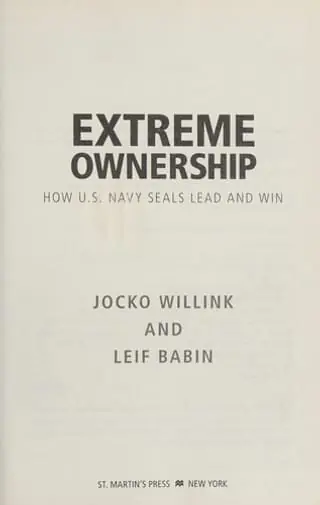
Extreme Ownership summary
by Jocko Willink and Leif Babin · 2015 · 7 key ideas · 18-minute read
Two former Navy SEAL officers argue that leaders own everything in their world — every failure, every plan, every team — and that this ownership is what makes teams win.
Why read it
For anyone who leads people, or wants to, and is tired of excuses — their own included. It turns battlefield lessons into blunt, usable rules for teams, projects and businesses.
Extreme Ownership in brief
Extreme Ownership is built from one hard idea: the leader is responsible for everything. Willink and Babin learned it in Ramadi, Iraq, in 2006, where their SEAL task unit fought one of the toughest urban battles of the war. Each chapter tells a combat or training story, pulls out a principle, then shows it working inside a real company the authors later coached.
The first part is about mindset. Leaders must take ownership of mistakes rather than blame others; there are no bad teams, only bad leaders; leaders must believe in the mission before they can sell it; and ego is the quiet enemy that stops people from admitting error or asking for help.
The second part covers the four ‘laws of combat’: Cover and Move (teams support each other, not just themselves), Simple (plans everyone can understand), Prioritize and Execute (tackle the biggest problem first, then the next), and Decentralized Command (junior leaders decide within a clear intent).
The final part is about sustaining success: planning carefully, leading up the chain of command as well as down, acting decisively when information is incomplete, and building discipline. Their closing paradox is that discipline is what creates freedom. The tone is direct, the stakes are real, and the lesson is consistent: stop looking for someone to blame and start fixing what you can control — which is more than you think.
The 7 key ideas
1. Own everything
If it's their fault, you're stuck. If it's yours, you can fix it.
2. No bad teams, only bad leaders
It's not what you preach, it's what you tolerate.
3. Believe — and check the ego
Understand the why before you hand down the what.
4. Cover and move
If the mission fails, nobody's department wins.
5. Keep it simple
If they can't repeat it, it isn't simple enough.
6. Prioritize and execute
Relax, look around, make a call.
7. Decentralized command
Explain the why, set the limits, then get out of the way.
Read the full guide in Kinquire. Every idea with a real example, a diagram and one thing to try today, plus a quick quiz so it sticks. Free to start.
Read Extreme OwnershipKey takeaways
- When something fails, start by asking what you could have done differently — then say it out loud.
- Decide which standards matter and stop tolerating the gaps you've been letting slide.
- Make every plan simple enough that the newest person can explain it back.
- Under pressure, step back and work on one priority at a time.
- Give your team clear intent and clear limits, then let them decide within them.
Our take
The book's strength is its clarity: ownership is a genuinely useful default, and the combat stories make the lessons memorable. The business case studies are thinner and sometimes read like tidy morals. Critics point out that the authors' own sequel had to add balance — owning everything can tip into control, and ‘no bad teams, only bad leaders’ ignores cases where hiring, resources or company culture are the real problem. The military framing also suits some workplaces better than others. Still, as a mindset correction for leaders who reach for excuses, it has held up well and remains widely used.
About Jocko Willink and Leif Babin
Jocko Willink and Leif Babin served together as Navy SEAL officers in Task Unit Bruiser during the 2006 battle of Ramadi, Iraq. After leaving the Navy they founded the leadership consultancy Echelon Front.
If you liked this
- Turn the Ship Around! by L. David Marquet
- Team of Teams by Stanley McChrystal
- Ego Is the Enemy by Ryan Holiday
- Good to Great by Jim Collins
- Built to Last by Jim Collins and Jerry I. Porras
- The Innovator's Dilemma by Clayton M. Christensen