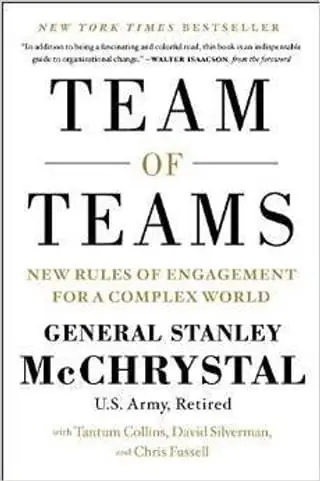
Team of Teams summary
by Stanley McChrystal · 2015 · 7 key ideas · 18-minute read
In a fast, interconnected world, efficient top-down organisations are too slow; they must become networks of small teams sharing information widely and deciding locally.
Why read it
For leaders of large organisations struggling with silos and slow decisions. It explains why traditional structures break down under complexity and how one of the most hierarchical organisations in the world rebuilt itself to adapt.
Team of Teams in brief
When McChrystal took command of the Joint Special Operations Command in Iraq in 2003, his task force was among the best-trained, best-equipped forces in the world. Yet it was losing ground to al-Qaeda in Iraq, a loose, decentralised network that adapted faster than the task force's chain of command could respond.
The book argues that the problem wasn't skill but structure. Organisations designed for efficiency — breaking work into specialised parts, controlled from the top — work well in predictable environments. In a complex, fast-changing world, they can't adapt fast enough. Small teams can, because members trust each other and share a purpose, but teams don't naturally scale.
McChrystal's solution was a ‘team of teams’: an organisation where the relationships between teams resemble those within a team. That required two shifts. ‘Shared consciousness’ — radical transparency, so everyone understands the whole picture. And ‘empowered execution’ — pushing decisions down to those closest to the action.
Finally, the leader's role changes from controlling every move, like a chess master, to creating the conditions for the organisation to thrive, like a gardener. The book draws on history, science and business examples to argue that these lessons apply well beyond the military.
The 7 key ideas
1. Efficiency isn't enough
Efficient isn't the same as effective when the world keeps changing.
2. Complicated vs complex
You can plan for complicated; you must adapt to complex.
3. Teams adapt because they trust
Teams adapt because they trust, not because they plan.
4. Build a team of teams
Connect the teams like you connect the people.
5. Shared consciousness
Share by default; you can't predict who needs what.
6. Empowered execution
Share everything, then let them decide.
7. Lead like a gardener
Don't move the pieces — tend the garden.
Read the full guide in Kinquire. Every idea with a real example, a diagram and one thing to try today, plus a quick quiz so it sticks. Free to start.
Read Team of TeamsKey takeaways
- Find where information gets stuck on its way to the people who can act on it.
- Treat complex problems with fast feedback, not detailed prediction.
- Build personal links between teams that depend on each other.
- Share information by default rather than by permission.
- Push decisions down once people understand the whole picture.
- Spend your time shaping conditions, not approving moves.
Our take
Team of Teams offers a compelling diagnosis of why big organisations struggle with speed and silos, and its concepts — shared consciousness, empowered execution, the gardener leader — are memorable and widely used. Its weaknesses: the evidence is mainly McChrystal's own experience, and the book doesn't fully examine costs, failures, or the moral complexity of the war it describes. Its business examples are thinner than the military story. Transferring a wartime task force's model to companies without its urgency and shared mission is harder than the book suggests. Still, it's an influential account of leading in complexity.
About Stanley McChrystal
Stanley McChrystal is a retired US Army general who led the Joint Special Operations Command (JSOC) during the Iraq war and later commanded US and NATO forces in Afghanistan. He wrote this book with Tantum Collins, David Silverman and Chris Fussell.
If you liked this
- Turn the Ship Around! by L. David Marquet
- Extreme Ownership by Jocko Willink and Leif Babin
- Antifragile by Nassim Nicholas Taleb
- Good to Great by Jim Collins
- Built to Last by Jim Collins and Jerry I. Porras
- The Innovator's Dilemma by Clayton M. Christensen