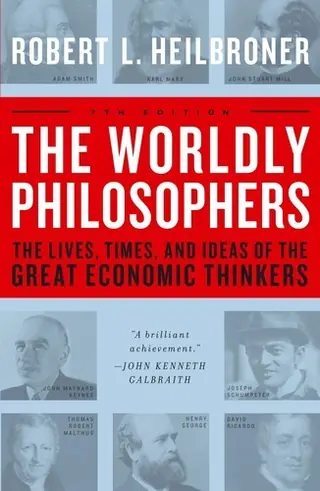
The Worldly Philosophers summary
by Robert L. Heilbroner · 1953 · 8 key ideas · 20-minute read
A lively history of the great economists, from Adam Smith to Keynes and Schumpeter, showing how each tried to understand the strange new machine of capitalism and where it was heading.
Why read it
For anyone who wants to understand where today's economic ideas came from, told through the colourful lives of the thinkers who shaped them.
The Worldly Philosophers in brief
Heilbroner calls the great economists 'worldly philosophers' because they tried to explain the most worldly of things, how people earn their living, using the ambition of philosophy. He begins by showing that the market system is a recent invention. For most of history, societies organized production through tradition or command, not through buying and selling.
Adam Smith was the first to describe the new market society as a coherent system with its own laws. After him came darker visions. Thomas Malthus feared that population would always outrun food, and David Ricardo saw landlords gaining at everyone else's expense. The utopian socialists, such as Robert Owen, tried to build better societies, while Karl Marx argued that capitalism would destroy itself through its own contradictions.
In the late nineteenth and early twentieth centuries, Heilbroner follows the economists of the Victorian era and the 'underworld' of heretics, such as Henry George. Thorstein Veblen mocked the wasteful rituals of the rich. John Maynard Keynes, facing the Great Depression, showed that an economy could get stuck in mass unemployment and argued that government had to act.
Joseph Schumpeter saw capitalism's dynamism in waves of entrepreneurial innovation, but predicted that its very success might undermine it. Heilbroner ends by reflecting on what these thinkers had in common: each offered a vision of where society was heading, and each reminds us that economics is ultimately about the fate of human societies.
The 8 key ideas
1. The market is new
The market isn't natural; it's an invention.
2. Smith's self-regulating society
Competition, not kindness, keeps the market honest.
3. The gloomy forecasters
Forecasts of doom often miss the next invention.
4. The utopians
One working example beats a hundred blueprints.
5. Marx's inexorable system
Capitalism never stands still; Marx saw that before most.
6. Veblen's leisure class
Some prices are paid to be seen.
7. Keynes: the economy can get stuck
One person's spending is another's income.
8. Schumpeter: creative destruction
Innovation builds by destroying, so be the builder.
Read the full guide in Kinquire. Every idea with a real example, a diagram and one thing to try today, plus a quick quiz so it sticks. Free to start.
Read The Worldly PhilosophersKey takeaways
- Remember that markets are a human invention, not a law of nature.
- Ask who captures the gains from growth, as Ricardo did.
- Test bold economic ideas with small, practical pilots, like Owen did.
- Notice when you're buying status rather than use.
- In downturns, consider how individual caution adds up to collective harm.
- Expect creative destruction in your field and prepare to adapt.
Our take
The Worldly Philosophers remains one of the most enjoyable introductions to the history of economic thought, combining vivid biography with clear explanations. Its strength is showing that economic ideas grow out of their time and their authors' lives. But it's selective: it focuses on a small group of mostly European and American men and skips many important later developments, including modern mathematical and empirical economics. Some judgments reflect when the book was written and revised. Treat it as a gateway to these thinkers, not a complete history of the field.
About Robert L. Heilbroner
Robert Heilbroner was an American economist who taught for many years at The New School for Social Research in New York. The Worldly Philosophers became one of the best-selling economics books ever written.
If you liked this
- The Wealth of Nations by Adam Smith
- Capital in the Twenty-First Century by Thomas Piketty
- The Psychology of Money by Morgan Housel
- Rich Dad Poor Dad by Robert T. Kiyosaki
- The Intelligent Investor by Benjamin Graham
- I Will Teach You to Be Rich by Ramit Sethi