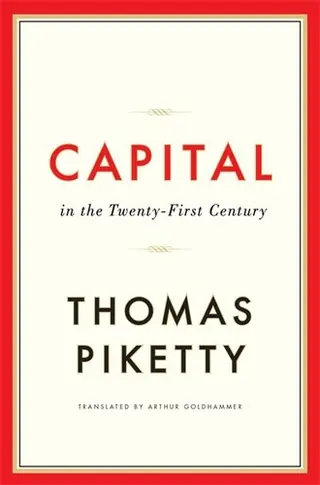
Capital in the Twenty-First Century summary
by Thomas Piketty · 2013 · 8 key ideas · 22-minute read
Using centuries of tax data, Piketty argues that when the return on wealth outpaces economic growth, inherited fortunes grow faster than everything else, and inequality rises unless politics intervenes.
Why read it
For anyone who wants to understand the modern debate about inequality: it reshaped how economists, politicians and journalists talk about wealth, inheritance and taxation.
Capital in the Twenty-First Century in brief
Piketty sets out to answer an old question with new evidence: does capitalism naturally make wealth more or less concentrated over time? With colleagues, he assembled income and wealth data from tax records and estate archives covering more than two centuries and about twenty countries, especially France, Britain and the United States.
The data show a U-shaped history. Inequality was extremely high in Europe before the First World War, when inherited wealth dominated. Two world wars, the Great Depression, inflation and new taxes destroyed or redistributed much of that wealth, and the decades after 1945 were unusually equal. Since around 1980, inequality has been rising again, sharply in the United States.
His central explanation is the inequality r > g. Over most of history, the average return on capital has been higher than the growth rate of the economy. When that holds, wealth that already exists, especially inherited wealth, grows faster than wages and output, so the past tends to dominate the future. The mid-twentieth century was the exception, not the rule.
Piketty argues that nothing in the market will automatically reverse this. With slower growth ahead, he warns of a return to a 'patrimonial' capitalism dominated by inheritance. His proposed remedy is a progressive global tax on capital, backed by financial transparency, which he admits is utopian but argues is the right direction.
The 8 key ideas
1. r > g
When r beats g, the past devours the future.
2. The U-shaped century
The equal century was the exception, not the rule.
3. Kuznets got it backwards
Equality isn't automatic; it is made or unmade.
4. Slow growth makes capital matter more
Slow growth turns savings into a mountain.
5. The return of inherited wealth
When wealth outruns wages, Vautrin's advice comes back.
6. Supermanagers and top salaries
Lower top taxes, higher top pay: incentives cut both ways.
7. Big fortunes grow faster
Money compounds, and big money compounds faster.
8. A global tax on capital
You can't tax what you can't see.
Read the full guide in Kinquire. Every idea with a real example, a diagram and one thing to try today, plus a quick quiz so it sticks. Free to start.
Read Capital in the Twenty-First CenturyKey takeaways
- Track how much of your wealth comes from work versus returns, and build your capital deliberately.
- Distrust claims that inequality will fix itself with growth; ask for the mechanism.
- Keep investment fees low, since small differences in returns compound over decades.
- Read inequality statistics with history in mind: the mid-twentieth century was unusual.
- When judging tax policy, consider both revenue and transparency about who owns what.
Our take
Capital in the Twenty-First Century transformed the inequality debate, chiefly through its huge historical data sets, which remain valuable whatever one makes of the theory. Its weaknesses are mostly in the interpretation. Critics argue that the rise in capital's share is largely about housing, that r > g alone doesn't explain rising top incomes, that the 'second law' overstates future capital growth, and that institutions and politics matter more than the formula implies (a point Piketty partly accepts). Some data choices were also challenged in the press. It's long, but the core argument is clearer and more readable than its size suggests.
About Thomas Piketty
Thomas Piketty is a French economist and professor at the Paris School of Economics. Much of his research, with colleagues such as Emmanuel Saez and Anthony Atkinson, built long-run data on top incomes from tax records.
If you liked this
- Why Nations Fail by Daron Acemoglu and James A. Robinson
- The Worldly Philosophers by Robert L. Heilbroner
- The Psychology of Money by Morgan Housel
- Rich Dad Poor Dad by Robert T. Kiyosaki
- The Intelligent Investor by Benjamin Graham
- I Will Teach You to Be Rich by Ramit Sethi