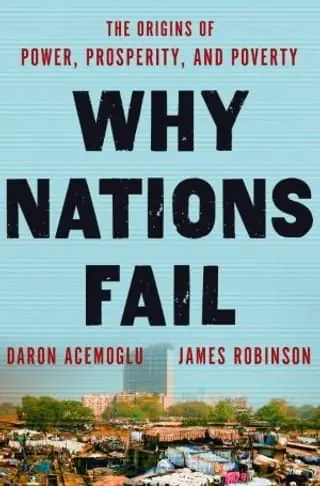
Why Nations Fail summary
by Daron Acemoglu and James A. Robinson · 2012 · 7 key ideas · 20-minute read
Nations grow rich when their political and economic institutions include and empower the many, and stay poor when institutions are built to let a narrow elite extract wealth.
Why read it
For anyone who has wondered why some countries prosper while their neighbours stay poor: it offers one big, clear framework that connects history, politics and economics.
Why Nations Fail in brief
Why are some nations rich and others poor? Acemoglu and Robinson reject the usual answers. Geography doesn't explain why neighbouring countries with the same climate diverge. Culture doesn't explain why the same people prosper under one system and stagnate under another. And poor countries aren't poor because their leaders don't know the right policies.
Their answer is institutions: the rules, both economic and political, that shape incentives. Inclusive economic institutions protect property, enforce contracts, allow free entry and give people a reason to invest and innovate. They are sustained by inclusive political institutions, which spread power widely and keep the state strong enough to enforce the rules. Extractive institutions do the opposite, concentrating power and wealth in a narrow elite.
Using examples from ancient Rome to modern Zimbabwe, the authors show how institutions are shaped at critical junctures, such as the Black Death, the Glorious Revolution in England or the colonization of the Americas, when small differences can send societies down very different paths. Once established, institutions tend to reinforce themselves through virtuous or vicious circles.
Extractive regimes can grow for a while, as the Soviet Union did, but they fear the creative destruction that sustained growth requires, because new technologies and new wealth threaten the elite's power. Lasting prosperity, the authors conclude, depends on broad political empowerment, which cannot simply be engineered from outside.
The 7 key ideas
1. One town, two fates
Same people, different rules, different futures.
2. Not geography, culture or ignorance
Poverty is often a choice made by those in charge.
3. Inclusive versus extractive
Who holds power decides who gets to prosper.
4. Elites fear creative destruction
Progress threatens someone. Watch who is blocking it.
5. Critical junctures
In a crisis, small differences become big destinies.
6. Virtuous and vicious circles
Changing the rulers isn't the same as changing the rules.
7. Extractive growth runs out
Command can build factories. Only freedom keeps inventing.
Read the full guide in Kinquire. Every idea with a real example, a diagram and one thing to try today, plus a quick quiz so it sticks. Free to start.
Read Why Nations FailKey takeaways
- When comparing outcomes, look first at the rules and incentives people live under.
- Ask who holds power and who benefits before assuming bad results come from ignorance.
- Watch for incumbents blocking new ideas that threaten their position.
- Use crises as moments to open up systems rather than tighten control.
- Spread decision-making power widely to make good rules self-reinforcing.
Our take
Why Nations Fail is bold, readable and full of history, and its core claim, that institutions and the distribution of power are central to prosperity, has become mainstream, helped by the authors' Nobel Prize. Critics argue that 'inclusive' and 'extractive' are defined loosely enough to fit almost any case after the fact, that the book underrates geography, culture and disease, and that China's long boom fits awkwardly. It also offers few practical steps for how nations can actually build inclusive institutions. Read it as a powerful lens rather than a precise predictive theory.
About Daron Acemoglu and James A. Robinson
Daron Acemoglu is an economist at MIT and James Robinson is a political scientist and economist at the University of Chicago. In 2024 they shared the Nobel Prize in economics with Simon Johnson for research on how institutions shape prosperity.
If you liked this
- Guns, Germs, and Steel by Jared Diamond
- Capital in the Twenty-First Century by Thomas Piketty
- Poor Economics by Abhijit V. Banerjee and Esther Duflo
- The Psychology of Money by Morgan Housel
- Rich Dad Poor Dad by Robert T. Kiyosaki
- The Intelligent Investor by Benjamin Graham