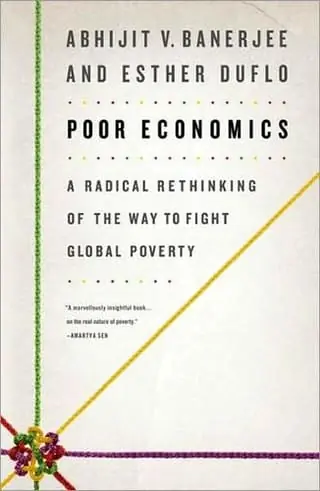
Poor Economics summary
by Abhijit V. Banerjee and Esther Duflo · 2011 · 8 key ideas · 20-minute read
Instead of grand theories about aid, fight poverty by understanding how poor people actually make decisions and testing specific solutions with careful experiments.
Why read it
For anyone who cares about global poverty and wants evidence rather than slogans: it shows what works, what doesn't, and why the poor's choices make more sense than outsiders assume.
Poor Economics in brief
Debates about global poverty are often stuck between big claims: aid works and should be massively increased, or aid fails and markets will do the job. Banerjee and Duflo think both camps ask the wrong question. Instead of asking whether aid works in general, they ask specific ones: how do you get children vaccinated, teachers to teach, families to save?
Their method is to look closely at how poor people live and to test interventions with randomized controlled trials, comparing groups who receive a programme with similar groups who don't. Drawing on research across many countries, they explore food, health, education, family size, risk, credit, saving and business.
The picture that emerges is of poor people making reasonable decisions in very difficult conditions. They often lack key information, face risks with no insurance, and must make many choices that richer people have made for them by default, such as clean water or automatic savings. Small barriers, like a short walk or a small cost, can have outsized effects.
The authors conclude that there is no single solution to poverty, but many specific improvements can make a large difference. Policies fail less because of evil than because of ideology, ignorance and inertia. Careful thinking and evidence, applied one problem at a time, can slowly change millions of lives.
The 8 key ideas
1. Ask small questions, test the answers
Not 'does aid work?' but 'does this work, here?'
2. Poverty traps exist sometimes
Some traps are real. Find out which before you push.
3. The poor are choosing, not just surviving
Before judging a choice, find out what it's for.
4. Small incentives, big health gains
Make the good choice easy, and reward it a little.
5. Teach at the right level
Start where the learner is, not where the syllabus is.
6. Microcredit helps, but doesn't transform
Useful isn't the same as transformative.
7. Poor people carry more decisions
Willpower is scarce. Defaults are free.
8. Ideology, ignorance, inertia
Most failures are lazy, not evil. That's good news.
Read the full guide in Kinquire. Every idea with a real example, a diagram and one thing to try today, plus a quick quiz so it sticks. Free to start.
Read Poor EconomicsKey takeaways
- Break big problems into specific questions and test possible fixes.
- Understand how people actually make choices before designing help for them.
- Use small rewards and convenience to encourage preventive actions.
- Teach and learn at the level you're really at, not the one you're supposed to be at.
- Automate good decisions so they don't depend on daily willpower.
- Challenge routines kept alive by ideology, ignorance or inertia.
Our take
Poor Economics brought rigorous evidence and real empathy to debates about poverty, and helped make randomized trials central to development economics, a contribution recognized by the 2019 Nobel Prize. Its findings are carefully hedged and grounded in field research. Critics argue that the focus on small, testable interventions can neglect bigger forces, such as economic growth, industrial policy, trade and national institutions, which have done most to reduce poverty in countries like China. Others warn that results from one setting may not transfer to another. It's best read as a guide to fixing specific problems well.
About Abhijit V. Banerjee and Esther Duflo
Abhijit Banerjee and Esther Duflo are economists at MIT and co-founders of the Abdul Latif Jameel Poverty Action Lab (J-PAL). They shared the 2019 Nobel Prize in economics with Michael Kremer for their experimental approach to fighting poverty.
If you liked this
- Why Nations Fail by Daron Acemoglu and James A. Robinson
- The Psychology of Money by Morgan Housel
- Rich Dad Poor Dad by Robert T. Kiyosaki
- The Intelligent Investor by Benjamin Graham
- I Will Teach You to Be Rich by Ramit Sethi
- The Millionaire Next Door by Thomas J. Stanley and William D. Danko