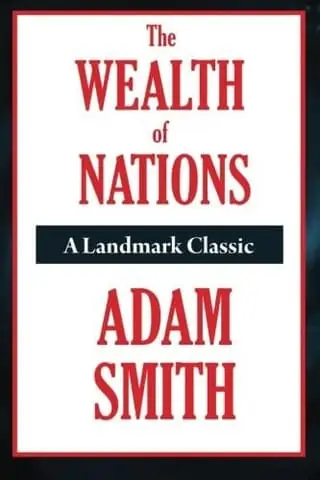
The Wealth of Nations summary
by Adam Smith · 1776 · 8 key ideas · 21-minute read
A nation grows rich not by hoarding gold but by dividing labour, widening markets and letting free exchange channel self-interest into the common good, within rules that stop the powerful from rigging the game.
Why read it
For anyone who wants to understand where modern economics came from, and how much more subtle the 'father of capitalism' was than the slogans attached to his name.
The Wealth of Nations in brief
Smith's full title asks a simple question: what makes some nations rich and others poor? His answer begins in a pin workshop. When work is divided into specialized tasks, output per worker multiplies. That division of labour, in turn, depends on the size of the market, and markets grow through trade, roads, rivers and money.
Smith then explains how prices work. In a competitive market, the price of a good is pulled toward its 'natural' level, the cost of the wages, profits and rents needed to produce it. When supply and demand move prices away, resources flow in or out until they settle again. No one has to plan this; it emerges from people pursuing their own interests.
Much of the book attacks the mercantile system, the belief that wealth means gold and silver and that a nation should export as much and import as little as possible. Smith argues that real wealth is the yearly output of a nation's land and labour, and that tariffs, monopolies and trade restrictions mostly enrich well-connected merchants at the public's expense.
Finally, Smith sets out what government should do: defend the nation, administer justice, and provide public works and institutions, including basic education, that markets won't supply. He is no simple fan of business. He warns that merchants constantly seek to rig markets, and that dull, repetitive work can damage the minds of workers unless society takes care to educate them.
The 8 key ideas
1. Divide the work, multiply the output
Prosperity is specialization plus exchange.
2. The market sets the limit
Bigger markets allow narrower, better work.
3. Self-interest, harnessed by exchange
Appeal to their interest, not their kindness.
4. Prices find their level
High profits are an invitation; barriers decline it.
5. Wealth is what you produce, not what you hoard
Money measures wealth. Production is wealth.
6. The invisible hand, read carefully
The invisible hand needs competition and justice to work.
7. Watch the merchants
Pro-market isn't the same as pro-business.
8. What government must do
Free markets stand on public foundations.
Read the full guide in Kinquire. Every idea with a real example, a diagram and one thing to try today, plus a quick quiz so it sticks. Free to start.
Read The Wealth of NationsKey takeaways
- Specialize in what you do best and trade for the rest.
- Look for ways to widen your market so you can specialize further.
- Frame requests around the other person's interest, not their kindness.
- When a price stays high, look for what's blocking competition.
- Treat business lobbying for less competition with suspicion.
- Judge taxes by fairness, certainty, convenience and cost of collection.
Our take
The Wealth of Nations founded economics as a discipline, and its core insights on specialization, competition and trade remain central. But it's a long, sprawling eighteenth-century work, and parts are dated, such as its labour-based ideas about value and its distinction between 'productive' and 'unproductive' labour, which later economists dropped. Smith has also been claimed by many people who have read only a few of his lines. Read in full, he is as critical of monopolies and business lobbying as he is of government meddling, and far more concerned with workers' welfare than his reputation suggests.
About Adam Smith
Adam Smith was a Scottish philosopher who taught moral philosophy at the University of Glasgow. Before this book he wrote The Theory of Moral Sentiments (1759), a study of sympathy and moral judgment.
If you liked this
- The Worldly Philosophers by Robert L. Heilbroner
- Basic Economics by Thomas Sowell
- Economics in One Lesson by Henry Hazlitt
- The Psychology of Money by Morgan Housel
- Rich Dad Poor Dad by Robert T. Kiyosaki
- The Intelligent Investor by Benjamin Graham