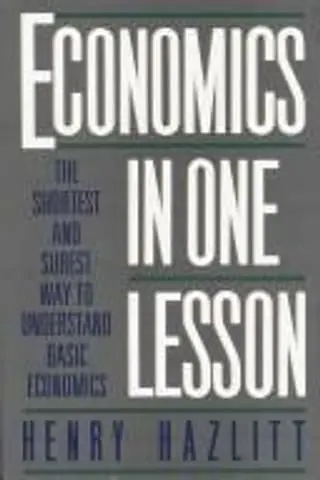
Economics in One Lesson summary
by Henry Hazlitt · 1946 · 7 key ideas · 18-minute read
Good economics means looking past the immediate, visible effects of a policy on one group to its long-run effects on everyone.
Why read it
For anyone who hears 'this will create jobs' and wants a simple, durable tool for checking whether it really will, and at whose expense.
Economics in One Lesson in brief
Hazlitt believed that most economic errors come from one mistake: looking only at the immediate effects of a policy, or only at its effects on one group, and ignoring the rest. His one lesson is to trace every policy's consequences over the long run and for all groups, not just the obvious beneficiaries.
He takes the core image from the nineteenth-century French writer Frédéric Bastiat. A boy breaks a baker's window; the glazier gets work, and onlookers conclude that destruction is good for business. They forget the suit the baker would have bought with that money. The repair is seen; the lost suit is unseen.
The rest of the book applies the lesson in short chapters. Public works financed by taxes destroy as many private jobs as they create. Machines raise living standards rather than causing permanent unemployment. Tariffs help a visible industry at the hidden expense of consumers and other industries. Price-fixing, rent control and minimum wages produce shortages or unemployment.
Hazlitt also attacks inflation as a hidden tax and defends saving as the source of investment. His conclusion is that most bad policies are not the result of malice but of a failure to follow consequences beyond the first, most visible step.
The 7 key ideas
1. The one lesson
Ask: then what? And for whom else?
2. The broken window
Look for the suit that was never bought.
3. Every public job has a hidden cost
Build it if it's worth it, not just for the jobs.
4. Machines make us richer
The goal is more output, not more busywork.
5. Tariffs protect the visible few
Protection helps the few you see and charges the many you don't.
6. Price-fixing backfires
You can fix a price, but not the scarcity behind it.
7. Inflation is a hidden tax
More money isn't more wealth.
Read the full guide in Kinquire. Every idea with a real example, a diagram and one thing to try today, plus a quick quiz so it sticks. Free to start.
Read Economics in One LessonKey takeaways
- For any policy, ask what happens in the long run and to groups not in the spotlight.
- Look for the 'unseen' alternative whenever someone claims spending creates jobs.
- Judge projects by whether they're worth their cost, not by how many jobs they employ.
- Expect price controls to produce shortages or surpluses somewhere.
- Protect your savings from inflation, which acts as a hidden tax.
Our take
Economics in One Lesson remains one of the most readable defences of free-market thinking, and its central habit, tracing hidden and long-run effects, is valuable to anyone. Its weakness is that it assumes economies normally run at full employment, so it dismisses the Keynesian argument that, in a deep slump, idle workers and money can make government spending a genuine gain. It also has little to say about market failures such as pollution or monopoly. Written in 1946 to argue against the policies of its day, it's best read as a powerful one-sided brief, not a complete account.
About Henry Hazlitt
Henry Hazlitt was an American journalist who wrote about economics and business for publications including The New York Times and Newsweek. He was a prominent popularizer of free-market economics.
If you liked this
- Basic Economics by Thomas Sowell
- Naked Economics by Charles Wheelan
- The Psychology of Money by Morgan Housel
- Rich Dad Poor Dad by Robert T. Kiyosaki
- The Intelligent Investor by Benjamin Graham
- I Will Teach You to Be Rich by Ramit Sethi