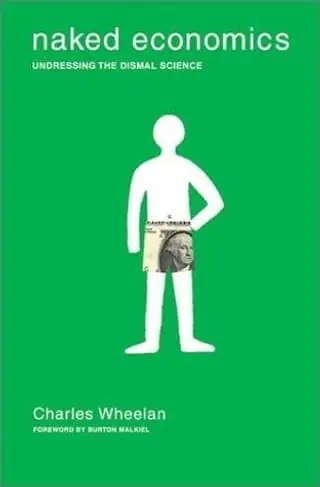
Naked Economics summary
by Charles Wheelan · 2002 · 8 key ideas · 20-minute read
Economics stripped of graphs and jargon: a friendly tour of markets, incentives, government, information, human capital, finance and trade, and why they matter in everyday life.
Why read it
For anyone who skipped economics at school, or suffered through it, and wants to understand the news, their pay cheque and public debates without equations.
Naked Economics in brief
Wheelan sets out to undress the 'dismal science', removing the graphs and formulas that put people off, to show that economics is really about how people make choices with limited resources. His tone is conversational and funny, and every idea is tied to something familiar.
The first part of the book explains how markets work. Prices and self-interest coordinate millions of strangers without central direction, and incentives explain a huge amount of behaviour, including when well-meant policies backfire. But markets aren't enough on their own. Government is needed to set rules, enforce contracts, provide public goods and deal with problems like pollution.
Wheelan then tours a series of key topics: how missing information distorts markets and why brands and credentials exist, why skills and education explain most differences in income, what economics says about investing, and how small, organized interest groups win favours at the public's expense.
The later chapters move to the big economy: measuring growth, how central banks manage money and inflation, international trade and globalization, and why some countries develop while others stay poor. Throughout, Wheelan presents mainstream economics as a powerful, practical toolkit that can make anyone a more thoughtful citizen.
The 8 key ideas
1. Markets coordinate strangers
Nobody's in charge, and it still works.
2. Incentives matter, and backfire
Reward something and you'll get more of it, including what you didn't mean.
3. Government makes markets possible
Good markets need good rules.
4. Information shapes markets
When buyers can't see quality, sellers must prove it.
5. Human capital drives income
Be hard to replace and you'll be hard to underpay.
6. You probably can't beat the market
Low fees, broad funds, long horizon.
7. Concentrated benefits, scattered costs
A few gain a lot, many lose a little, and the few win.
8. Trade makes both sides richer
Do what you do relatively best; trade for the rest.
Read the full guide in Kinquire. Every idea with a real example, a diagram and one thing to try today, plus a quick quiz so it sticks. Free to start.
Read Naked EconomicsKey takeaways
- Look for the incentives behind any behaviour or policy before judging it.
- Invest in skills that are valuable and hard to replace.
- Keep investing simple: diversified, low-cost and long-term.
- Ask who gains and who pays when you see a subsidy or protection.
- Specialize in what you do relatively best and trade or delegate the rest.
- Support rules that make markets work, not ones that protect insiders.
Our take
Naked Economics is one of the most accessible introductions to mainstream economics, and its humour and everyday examples make abstract ideas stick. It is fair-minded, presenting both the power of markets and the need for government. Its weaknesses are those of a broad survey: it skims complex debates, and its optimism about globalization and financial markets reflects the consensus of its time, which the 2008 financial crisis and later research on trade's local costs have complicated. Later editions have updated some material, but it's still best as a first step, not the last word.
About Charles Wheelan
Charles Wheelan is an American economist and writer who worked as a correspondent for The Economist and has taught public policy at universities including Dartmouth College. He later wrote Naked Statistics.
If you liked this
- The Undercover Economist by Tim Harford
- Freakonomics by Steven D. Levitt and Stephen J. Dubner
- Basic Economics by Thomas Sowell
- The Psychology of Money by Morgan Housel
- Rich Dad Poor Dad by Robert T. Kiyosaki
- The Intelligent Investor by Benjamin Graham