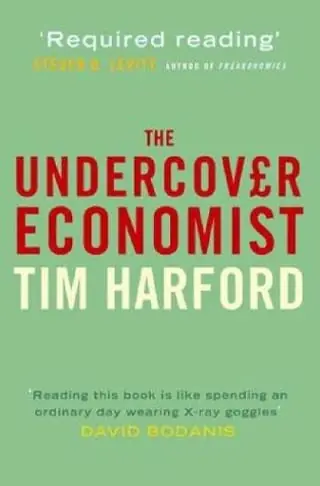
The Undercover Economist summary
by Tim Harford · 2005 · 7 key ideas · 18-minute read
Behind every cup of coffee, supermarket shelf and traffic jam is a hidden economic logic of scarcity, information and incentives, and learning to see it makes you a sharper consumer and citizen.
Why read it
For anyone who wants to understand why things cost what they do, how companies sort customers by willingness to pay, and why some countries stay poor, explained through everyday scenes.
The Undercover Economist in brief
Harford sets out to show that economics is everywhere, if you know how to look. He starts with an ordinary coffee bought near a busy station and asks who really profits from its price. The answer leads to scarcity power: whoever controls something scarce, from a prime location to a unique product, can capture much of the value.
He then explains how businesses try to charge each customer as much as they're willing to pay, through clever menus, premium versions and loyalty schemes. Against these tricks, he describes the ideal of perfect markets, in which prices tell the truth about costs and values and resources flow to their best uses.
Real markets fall short in identifiable ways. Pollution and traffic impose costs on others that prices ignore. Sellers may know far more than buyers, which can break markets for used cars or health insurance. Harford shows how smart policy, such as congestion charges or well-designed auctions, can repair some of these failures.
The final chapters widen the lens to globalization and development. Harford visits Cameroon to see why poor countries stay poor, finding the answer in broken institutions and corruption, and explains how trade, and China's opening to the world, have lifted hundreds of millions out of poverty.
The 7 key ideas
1. Scarcity power
Follow the scarcity and you'll find the profit.
2. Price targeting
The fancy option is a test of how little you check.
3. Prices that tell the truth
When prices lie, find which truth is missing.
4. Make people pay for the harm they cause
Price the harm and people stop over-buying it.
5. When sellers know more
Where trust is missing, quality leaves first.
6. Design the game, win the auction
Good rules make people reveal what they know.
7. Why poor countries are poor
Fix the incentives and people will build.
Read the full guide in Kinquire. Every idea with a real example, a diagram and one thing to try today, plus a quick quiz so it sticks. Free to start.
Read The Undercover EconomistKey takeaways
- Look for scarcity to understand who captures the profit in any business.
- Treat premium options and extras as tests of whether you check prices.
- Diagnose market problems by asking what's missing: competition, information or full costs.
- Support charges that make people pay for the harm they impose on others.
- When buying, ask what the seller knows that you don't, and when selling, prove your quality.
Our take
The Undercover Economist is one of the most enjoyable introductions to economics: clear, witty and full of everyday scenes that make abstract ideas concrete. It is strongest on microeconomics such as pricing, externalities and information, and gives a fair account of where markets fail as well as where they work. Its broad optimism about globalization was typical of the mid-2000s; later debates about the effect of trade on manufacturing communities and the 2008 financial crisis complicate that picture. Some examples are now dated, but the reasoning behind them has aged well.
About Tim Harford
Tim Harford is a British economist and journalist who writes the 'Undercover Economist' column for the Financial Times. He has also presented the BBC Radio 4 statistics programme More or Less.
If you liked this
- Freakonomics by Steven D. Levitt and Stephen J. Dubner
- Naked Economics by Charles Wheelan
- Why Nations Fail by Daron Acemoglu and James A. Robinson
- The Psychology of Money by Morgan Housel
- Rich Dad Poor Dad by Robert T. Kiyosaki
- The Intelligent Investor by Benjamin Graham