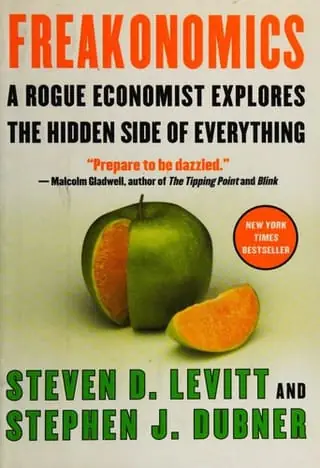
Freakonomics summary
by Steven D. Levitt and Stephen J. Dubner · 2005 · 7 key ideas · 19-minute read
An economist and a journalist use data to expose the hidden incentives behind cheating, crime, parenting and everyday life.
Why read it
For anyone who wants to think more sharply about cause and effect: it trains you to ask who gains, what the data really show, and why the obvious answer is so often wrong.
Freakonomics in brief
Freakonomics has no single theme, and says so proudly. Instead it applies one way of thinking to a string of odd questions: do teachers cheat, why do drug dealers live with their mothers, where did all the criminals go? The common thread is that incentives drive behavior, and that careful data can reveal what people would rather hide.
The first chapters are about incentives and information. A small fine for late pickups at day-care centers made parents later, not earlier. Teachers facing high-stakes tests quietly fixed their students' answers, and sumo wrestlers traded wins. Real-estate agents, who know more than their clients, sold their own homes for more by waiting longer.
The middle chapters attack conventional wisdom. A Chicago crack gang turns out to be organized like a franchise in which most workers earn less than the minimum wage, chasing a tiny chance at the top job. The big American crime drop of the 1990s, Levitt argues, owes less to clever policing and booming economies than to more police, more prisoners, a fading crack trade and, most controversially, legalized abortion.
The last chapters turn to parenting. Large data sets suggest that who parents are matters far more for a child's test scores than many things parents anxiously do. Even baby names tell a story, signaling parents' hopes and backgrounds rather than shaping a child's destiny.
The lasting lesson is a method rather than a conclusion. Be suspicious of tidy explanations, look for the incentive hiding underneath any behavior, ask who knows more than whom, and let the numbers speak before the story does. Used that way, the book is less a collection of curiosities than a training course in asking better questions.
The 7 key ideas
1. Incentives come in three flavors
Put a price on guilt and people will happily pay it.
2. Cheaters leave fingerprints in the data
Reward a number and someone will start bending it.
3. Experts use what you don't know
Before you weigh the advice, check how the adviser is paid.
4. Conventional wisdom is often wrong
Popular stories spread because they're convenient, not because they're true.
5. Big effects can have distant causes
The loudest explanation is rarely the whole one.
6. Who parents are beats what they do
Children watch who you are more than what you schedule.
7. Fear tracks outrage, not hazard
Feelings measure outrage. Statistics measure danger.
Read the full guide in Kinquire. Every idea with a real example, a diagram and one thing to try today, plus a quick quiz so it sticks. Free to start.
Read FreakonomicsKey takeaways
- Before designing any rule or reward, ask which economic, social and moral incentives it switches on or off.
- When an adviser helps you decide, find out how they are paid before you weigh their advice.
- When something dramatic happens, look for causes that started years earlier, not just the obvious ones.
- Treat popular explanations as hypotheses, and ask what data would prove them wrong.
- Spend your worry on common hazards rather than vivid, rare ones.
- Focus parenting energy on who you are and what you model, not on endless optimization.
Our take
Freakonomics made data-driven economics fun and popular, and its core habits (follow the incentive, distrust easy stories, check the numbers) still hold up. But its breezy style can make tentative findings sound settled. The abortion-crime argument remains hotly disputed, and correlations such as the parenting findings can't prove cause. The authors also later acknowledged that a source in their Ku Klux Klan chapter, Stetson Kennedy, had embellished his story. Read it as a brilliant toolkit for asking better questions, not as a set of final answers.
About Steven D. Levitt and Stephen J. Dubner
Steven Levitt is an economist at the University of Chicago who won the John Bates Clark Medal in 2003. Stephen Dubner is a journalist and author who later launched the Freakonomics Radio podcast.
If you liked this
- The Undercover Economist by Tim Harford
- Predictably Irrational by Dan Ariely
- Naked Economics by Charles Wheelan
- The Psychology of Money by Morgan Housel
- Rich Dad Poor Dad by Robert T. Kiyosaki
- The Intelligent Investor by Benjamin Graham