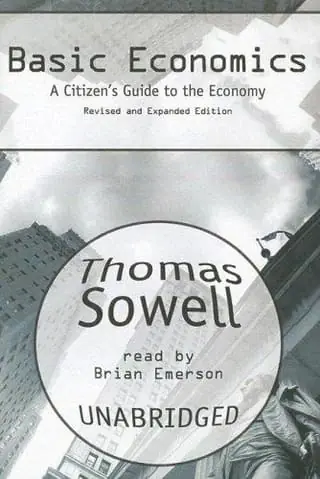
Basic Economics summary
by Thomas Sowell · 2000 · 7 key ideas · 18-minute read
Without a single graph or equation, Sowell shows how prices, profits and incentives allocate scarce resources, and why well-meant policies that ignore them so often backfire.
Why read it
For anyone who wants to reason clearly about rent control, minimum wages, trade or government programmes without a background in economics, and to judge policies by results rather than intentions.
Basic Economics in brief
Sowell starts from one definition: economics is the study of how scarce resources that have alternative uses are allocated. Because there's never enough of everything, every use of time, labour or materials means giving up some other use. The real question for any economy is how those trade-offs get made.
In a market economy, prices do most of that work. They carry information about what's scarce and what's wanted, and they give people reasons to economize or to produce more. Much of the book shows what happens when governments override prices: ceilings like rent control create shortages, floors like agricultural price supports create surpluses, and controls in general lead to queues, black markets and declining quality.
Sowell then covers industry and commerce, work and pay, time and risk, the national economy and international trade. He defends profits and losses as signals that move resources toward better uses, explains why central planning struggled in the Soviet Union, and argues that minimum wages tend to price the least experienced workers out of jobs.
Throughout, he urges readers to judge economic policies by their consequences, including indirect and long-run ones, not by the goals their supporters announce. The book has been revised and expanded through several editions, but its plain-language method stays the same.
The 7 key ideas
1. Scarcity means trade-offs
Everything costs whatever else it could have been.
2. Prices are messages
A price is a message. Don't shoot the messenger.
3. Price ceilings create shortages
Cap the price and you ration by queue instead.
4. Price floors create surpluses
A higher price is worthless if no deal happens.
5. Losses matter as much as profits
Profit says 'more of this'. Loss says 'stop'.
6. Planners can't know enough
No planner knows what a price knows.
7. Judge by results, not intentions
Good intentions are a hope, not a result.
Read the full guide in Kinquire. Every idea with a real example, a diagram and one thing to try today, plus a quick quiz so it sticks. Free to start.
Read Basic EconomicsKey takeaways
- Before any decision, name what you give up, not just what you pay.
- Treat price changes as information about scarcity, and respond to the signal.
- When something is cheap but hard to get, suspect a price that's being held too low.
- Look at both profits and losses as feedback on how well resources are used.
- Judge any policy by its incentives and long-run results, not its stated goals.
Our take
Basic Economics is one of the clearest introductions to how prices and incentives work, and its no-jargon style makes it unusually accessible. Its explanation of price controls reflects broad agreement among economists. But it is not a neutral textbook. Sowell is consistently sceptical of government intervention and spends far less time on market failures such as pollution, monopoly power or financial crises. On contested topics like minimum wages, he presents one side of a live research debate. It is best read alongside a more balanced text.
About Thomas Sowell
Thomas Sowell is an American economist and long-time senior fellow at Stanford University's Hoover Institution. He has written dozens of books on economics, history and social policy.
If you liked this
- Economics in One Lesson by Henry Hazlitt
- Naked Economics by Charles Wheelan
- The Wealth of Nations by Adam Smith
- The Psychology of Money by Morgan Housel
- Rich Dad Poor Dad by Robert T. Kiyosaki
- The Intelligent Investor by Benjamin Graham