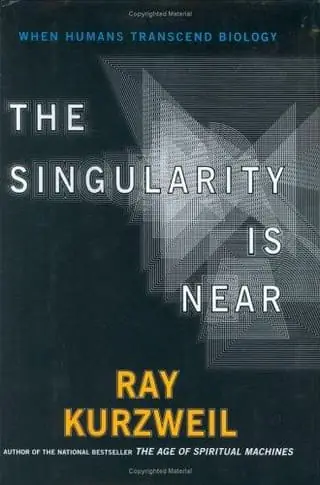
The Singularity Is Near summary
by Ray Kurzweil · 2005 · 7 key ideas · 17-minute read
Information technology grows exponentially, and within decades it will let us reverse-engineer the brain, merge with our machines and transcend biology — an event Kurzweil calls the Singularity.
Why read it
The definitive statement of techno-optimism. Read it to understand the exponential thinking behind much of Silicon Valley — and to test its bold predictions against what has actually happened.
The Singularity Is Near in brief
Kurzweil's core claim is the law of accelerating returns: evolution, biological and technological, builds on its own progress, so the pace of change itself speeds up. Information technologies — computing, sensing, genetic sequencing, brain scanning — improve exponentially, doubling in price-performance at regular intervals.
Because humans think linearly, we badly underestimate where this leads. Kurzweil lays out six epochs of evolution, from physics and chemistry through biology, brains and technology, to a coming merger of human and machine intelligence, and ultimately an intelligent universe.
He predicts three overlapping revolutions: genetics, letting us reprogram biology; nanotechnology, letting us build at the molecular scale; and robotics, by which he means strong AI. He forecasts that computers will match human intelligence by 2029 and that by 2045 non-biological intelligence will vastly exceed all human thought — the Singularity.
Kurzweil argues that humans won't be replaced but will merge with this technology, extending our lives and minds through biotech, nanobots and brain–computer links. He addresses critics at length and acknowledges serious dangers, from engineered viruses to self-replicating nanobots, arguing for defensive technologies rather than bans.
The 7 key ideas
1. The law of accelerating returns
Each tool builds the next, faster.
2. We think linearly in an exponential world
Exponentials look flat — until they don't.
3. Six epochs of evolution
Each epoch builds the next — and faster.
4. 2029 and 2045
Make predictions specific enough to be wrong.
5. Genetics, nanotech, robotics
G, N, R: life, matter, mind — reprogrammed.
6. We will merge with our machines
You're not your atoms; you're your pattern.
7. Promise and peril
Don't ban the fire; build the extinguisher.
Read the full guide in Kinquire. Every idea with a real example, a diagram and one thing to try today, plus a quick quiz so it sticks. Free to start.
Read The Singularity Is NearKey takeaways
- Check whether a trend is linear or exponential before you plan around it.
- Make your predictions specific and dated so you can learn from them.
- Watch for new paradigms when an old technology hits its limits.
- Think about identity and what you'd want to preserve as tech advances.
- Support targeted defences against risks rather than blanket fear.
Our take
The Singularity Is Near is ambitious, data-rich and influential; its exponential charts shaped how many technologists think. Some predictions have aged well, especially on computing power and conversational AI. But critics argue Kurzweil cherry-picks trends, underestimates the complexity of biology and the brain, and treats speculative ideas — nanobots, mind uploading — as near-certain. Life extension and molecular nanotech remain far behind his schedule. Read it as a powerful argument for taking exponential change seriously, not as a reliable timetable.
About Ray Kurzweil
Ray Kurzweil is an American inventor known for early reading machines for the blind and electronic music synthesisers. He joined Google in 2012 to work on machine learning and language.
If you liked this
- Superintelligence by Nick Bostrom
- Life 3.0 by Max Tegmark
- Homo Deus by Yuval Noah Harari
- Human Compatible by Stuart Russell
- The Coming Wave by Mustafa Suleyman with Michael Bhaskar
- Chip War by Chris Miller