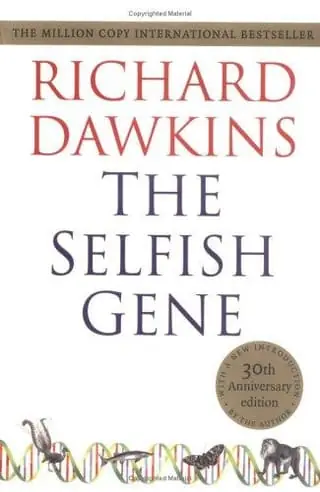
The Selfish Gene summary
by Richard Dawkins · 1976 · 7 key ideas · 19-minute read
Evolution makes most sense from the gene's point of view: bodies are temporary vehicles built by genes that have survived by getting themselves copied.
Why read it
For anyone who wants to understand why animals (including us) cooperate, compete, care for kin and cheat — and to learn a way of thinking that changed biology.
The Selfish Gene in brief
Dawkins asks a simple question with big consequences: what is natural selection actually selecting? His answer is the gene. Long ago, molecules that could copy themselves appeared in the primeval soup. Those that copied well spread. Over billions of years they built ever more elaborate 'survival machines' to protect and carry them — cells, plants, animals and us.
Seen this way, an organism is a temporary vehicle and genes are the lasting replicators. A gene is 'selfish' only in a metaphorical sense: it behaves as if it were trying to get more copies of itself into future generations. Dawkins stresses this is not a moral claim, and that selfish genes can, and often do, build generous animals.
The rest of the book uses this lens to explain behaviour. Animals help relatives because relatives share genes. Fighting strategies settle into stable mixes, which Dawkins explains using game theory and John Maynard Smith's idea of an evolutionarily stable strategy. Parents and children, and males and females, have partly conflicting genetic interests, which predicts real tensions.
Cooperation among non-relatives can evolve too, if the same individuals meet repeatedly and can return favours or punish cheats. In later editions Dawkins added a chapter on computer tournaments showing that 'nice' but retaliatory strategies tend to win, which suggests generosity is not naive when relationships last.
Finally, he proposes that culture has its own replicators — 'memes' such as tunes, ideas and fashions that spread from brain to brain. And he ends on a hopeful note: humans, uniquely, can understand where their impulses come from, and so can choose to rebel against their selfish replicators.
The 7 key ideas
1. The gene is the unit of selection
Bodies are temporary; recipes for bodies last.
2. We are survival machines
Genes write the program; brains play the game.
3. Selfish genes, kind animals
Help your kin, help your genes.
4. Strategies that can't be beaten
What lasts isn't the best — it's the unbeatable.
5. Families have built-in conflicts
Shared genes, shared interests — but never perfectly.
6. Nice guys can finish first
Be nice, be clear, be forgiving.
7. Memes: replicators of culture
What spreads isn't always what's true.
Read the full guide in Kinquire. Every idea with a real example, a diagram and one thing to try today, plus a quick quiz so it sticks. Free to start.
Read The Selfish GeneKey takeaways
- When a behaviour puzzles you, ask how it might help genes (or ideas) get copied.
- Expect some conflict even in close relationships; name shared and separate interests openly.
- Cooperate by default, but don't let yourself be exploited for long.
- Value long-term relationships — repeated contact is what makes cooperation pay.
- Treat catchy ideas with suspicion: being memorable is not the same as being true.
Our take
The Selfish Gene popularised a way of thinking that most evolutionary biologists still use, and it is unusually clear about hard ideas like kin selection and evolutionarily stable strategies. Its main risk is misreading: the title led some to think it endorses selfishness, which Dawkins repeatedly denies. Biologists still debate how much weight to give genes versus groups, development and environment, and newer fields such as epigenetics add complexity. Memes inspired a word more than a science. Read it as a powerful lens rather than the whole picture.
About Richard Dawkins
Richard Dawkins is a British evolutionary biologist who taught at Oxford, where he was the first holder of the Charles Simonyi Professorship for the Public Understanding of Science. The Selfish Gene was his first book.
If you liked this
- On the Origin of Species by Charles Darwin
- The Gene by Siddhartha Mukherjee
- A Brief History of Time by Stephen Hawking
- Cosmos by Carl Sagan
- A Short History of Nearly Everything by Bill Bryson
- Astrophysics for People in a Hurry by Neil deGrasse Tyson