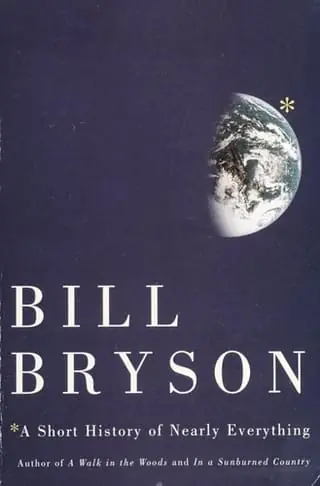
A Short History of Nearly Everything summary
by Bill Bryson · 2003 · 8 key ideas · 21-minute read
A funny, wide-eyed journey from the big bang to the rise of humans, told through the odd, brilliant people who worked out how we know what we know.
Why read it
For anyone who left school feeling science was a list of dry facts, and wants the whole story of the universe, Earth and life told with wonder, humour and gossip.
A Short History of Nearly Everything in brief
Bryson admits he knew almost nothing about science and set out to fix that. He wanted to know not only what scientists believe — how old the Earth is, what's inside an atom — but how on earth they found out. The book is the result: a grand tour told by an amused, curious outsider.
It starts with the universe: the big bang, the staggering emptiness of space, and the solar system. It then turns to Earth — how people weighed it, dated it, mapped its insides and discovered that continents drift. Along the way we meet eccentric geniuses, bitter rivalries, lucky accidents and brilliant ideas that were mocked for decades.
Next comes the dangerous planet. Asteroids, supervolcanoes, earthquakes and ice ages have all shaped life's history, and Bryson shows how close we live to catastrophe. Then he moves into atoms, cells and the history of life, from microbes that ran the planet for billions of years to dinosaurs and, finally, us.
Two themes run throughout. First, how improbable your existence is: countless chances had to fall the right way for you to be here. Second, how much we still don't know. Bryson ends with extinction, noting how often humans have wiped out other species, and asks us to take better care of the one planet we have.
The 8 key ideas
1. Ask: how do they know?
Every fact has a backstory worth knowing.
2. You are wildly improbable
You're the latest winner of a four-billion-year lottery.
3. Space is mostly nothing
Diagrams squeeze; the cosmos sprawls.
4. Deep time is very deep
Humans are the last millimetre on a very long ruler.
5. Science is gloriously human
Flawed people, tested ideas — that's how science works.
6. Right ideas can be ridiculed
Judge the evidence, not the messenger's badge.
7. Clever solutions, terrible side effects
Ask what else it does, not just what it does.
8. A dangerous planet, a fragile life
We're the first species that knows it can cause extinction.
Read the full guide in Kinquire. Every idea with a real example, a diagram and one thing to try today, plus a quick quiz so it sticks. Free to start.
Read A Short History of Nearly EverythingKey takeaways
- When you hear a fact, ask how anyone could know it.
- Remember how improbable your existence is; let it fuel gratitude.
- Judge ideas by evidence, not by who proposes them.
- Before embracing a clever new solution, look for its hidden side effects.
- Remember that species, including ours, are fragile — and act accordingly.
Our take
This is one of the most enjoyable introductions to science ever written, and its focus on how knowledge was won makes it more valuable than a fact list. Its weaknesses are the flip side: it is broad rather than deep, leans on anecdote, and specialists have pointed out small errors and oversimplifications. Some content has dated since 2003 — Pluto's status, discoveries like the Higgs boson and gravitational waves, and thousands of exoplanets. Use it as a joyful map of science, then go deeper with specialist books on topics that catch your interest.
About Bill Bryson
Bill Bryson is an American-born writer who has lived much of his life in Britain. Before this book he was best known for travel writing such as Notes from a Small Island and A Walk in the Woods.
If you liked this
- Cosmos by Carl Sagan
- The Body: A Guide for Occupants by Bill Bryson
- Astrophysics for People in a Hurry by Neil deGrasse Tyson
- A Brief History of Time by Stephen Hawking
- The Selfish Gene by Richard Dawkins
- The Gene by Siddhartha Mukherjee