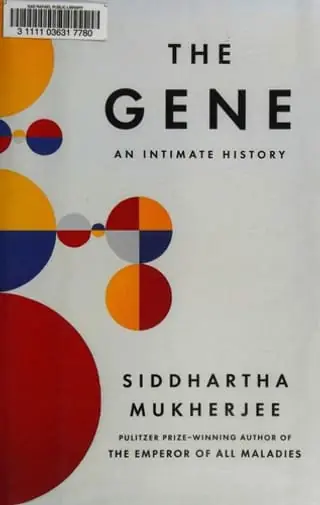
The Gene summary
by Siddhartha Mukherjee · 2016 · 7 key ideas · 20-minute read
The history of the gene — from Mendel's peas to gene editing — woven with a family story, showing how heredity became one of the most powerful and dangerous ideas in science.
Why read it
For anyone who wants to understand what genes really do (and don't do), why genetic 'destiny' is a misleading idea, and the ethical choices that gene editing now forces on all of us.
The Gene in brief
Mukherjee calls the gene one of the three most powerful ideas of the twentieth century, alongside the atom and the byte. He frames the book with his own family: several relatives in India, including uncles and a cousin, suffered from serious mental illness. Was it in the family's genes, and if so, what did that mean for him and his children?
The history begins with heredity as a mystery. Darwin explained evolution but not inheritance. Gregor Mendel, an Austrian friar breeding peas, found that traits pass on as discrete units, but his work lay ignored for decades. In the twentieth century researchers showed genes sit on chromosomes, are made of DNA, and work by coding for proteins.
The story has a dark middle. The idea that heredity could be managed gave rise to eugenics, which led to forced sterilisation in the United States and to the murderous policies of Nazi Germany. Mukherjee insists these chapters are not a sidebar: they show what happens when crude genetic ideas meet political power.
Then come the modern tools: cutting and pasting DNA, sequencing the human genome, finding genes for diseases, epigenetics, and finally editing genes with technologies like CRISPR. Each advance moved us from reading the genetic code towards writing it, and each brought new hopes for treating disease alongside new fears about misuse.
Mukherjee ends with the questions we now face. Genes shape us powerfully, but rarely deterministically; environment and chance matter enormously. As we gain the power to alter our own heredity, he argues, we need clear thinking about which changes, if any, we should make.
The 7 key ideas
1. Heredity comes in units
Heredity is shuffled, not stirred.
2. Genes are instructions
DNA writes, RNA carries, protein does.
3. Eugenics: a warning
Bad genetics plus power is a dangerous mix.
4. Genes load the dice
Genes deal the cards; life plays the hand.
5. Reading the whole book
It's not how many genes — it's how they're played.
6. Same genes, different cells
Same script, different highlighting.
7. From reading to writing
The power to edit demands the wisdom to choose.
Read the full guide in Kinquire. Every idea with a real example, a diagram and one thing to try today, plus a quick quiz so it sticks. Free to start.
Read The GeneKey takeaways
- Treat most 'gene for X' headlines as shifts in probability, not destiny.
- Learn the history of eugenics before debating genetic selection.
- Ask how severe, how certain and how freely chosen any genetic intervention is.
- Remember that environment and chance shape outcomes alongside genes.
- If you take a genetic test, get proper counselling on what the results do and don't mean.
Our take
The Gene is a rich, humane history that ties hard science to moral consequences, and its family thread makes heredity feel personal. Its treatment of eugenics is a valuable corrective to triumphalist science stories. It is long and sometimes lyrical to the point of excess, and the chapters on epigenetics drew criticism from geneticists for overstating some mechanisms. The field has moved quickly since 2016 — CRISPR therapies are reaching patients and the first germline editing scandal has happened — so the final chapters read as an early map of a fast-changing landscape.
About Siddhartha Mukherjee
Siddhartha Mukherjee is an Indian-American cancer physician and researcher at Columbia University. His earlier book, The Emperor of All Maladies, won the 2011 Pulitzer Prize for General Nonfiction.
If you liked this
- The Emperor of All Maladies by Siddhartha Mukherjee
- The Selfish Gene by Richard Dawkins
- The Immortal Life of Henrietta Lacks by Rebecca Skloot
- A Brief History of Time by Stephen Hawking
- Cosmos by Carl Sagan
- A Short History of Nearly Everything by Bill Bryson