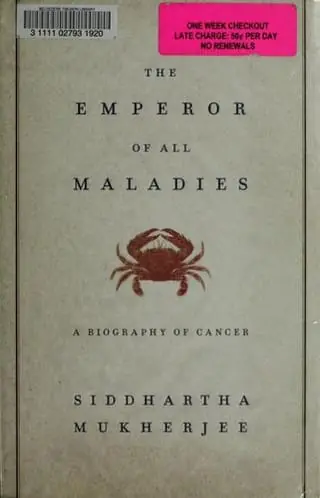
The Emperor of All Maladies summary
by Siddhartha Mukherjee · 2010 · 7 key ideas · 19-minute read
An oncologist writes a 'biography' of cancer, tracing four thousand years of attempts to understand and defeat a disease that arises from our own cells.
Why read it
For anyone touched by cancer or curious about how medicine really advances. It explains what cancer is, why it is so hard to cure, and how progress came from bold ideas, painful mistakes and careful trials.
The Emperor of All Maladies in brief
Mukherjee frames the book as a biography of cancer, following the disease from its first recorded descriptions in ancient Egypt to modern genetics. Alongside the history, he weaves in stories from his own training as a cancer doctor and the experiences of his patients.
The early chapters show how for most of history cancer was poorly understood and almost untreatable. Surgeons then tried to cut it out ever more aggressively, culminating in radical operations that were eventually shown to be no better than gentler ones.
The twentieth century brought chemotherapy, beginning with Sidney Farber's experiments on children with leukaemia, and a political 'war on cancer' driven by activists such as Mary Lasker. Some cancers, like childhood leukaemia and Hodgkin's lymphoma, became curable, but many common cancers resisted.
Meanwhile, two other fronts opened. Prevention, especially the long fight to link smoking with lung cancer, saved enormous numbers of lives. And laboratory science revealed that cancer is caused by mutations in our own genes that switch on growth and switch off restraints.
The book ends with targeted drugs aimed at specific genetic faults, such as imatinib for chronic myeloid leukaemia, and a sober message: cancer is so tied to our own biology that progress will come in steady steps rather than a single cure.
The 7 key ideas
1. An ancient disease of our own cells
Cancer is us, gone rogue.
2. More radical isn't better
Intuition guesses; trials decide.
3. The birth of chemotherapy
One drug, relapse; many drugs, cure.
4. Wars on cancer need patience
You can't win a war you don't yet understand.
5. Prevention: the smoking story
The best cancer treatment is the cancer that never starts.
6. Accelerators and brakes
Stuck accelerator, broken brakes, runaway cell.
7. Targeted drugs and the Red Queen
Against cancer, you run just to stay in place.
Read the full guide in Kinquire. Every idea with a real example, a diagram and one thing to try today, plus a quick quiz so it sticks. Free to start.
Read The Emperor of All MaladiesKey takeaways
- Don't smoke, and support others in quitting; it's the biggest preventable cancer risk.
- Keep up with recommended cancer screening and vaccines such as HPV.
- Know your family history and share it with your doctor.
- Be sceptical of 'miracle cure' headlines; ask what stage of evidence they represent.
- Respect randomised trials: confident intuition has misled medicine before.
Our take
The Emperor of All Maladies is widely regarded as a masterpiece of science writing: rigorous, humane and gripping, and it won a Pulitzer Prize. It explains cancer's biology and history with rare clarity and shows honestly how medicine progresses through trial, error and evidence. Its limits are mostly of scope and time. It focuses heavily on American institutions, and some readers find its length and detail demanding. Published in 2010, it predates the rise of cancer immunotherapy and newer genomic tools, so the frontier has moved since, but its central lessons remain sound.
About Siddhartha Mukherjee
Siddhartha Mukherjee is an Indian-born American oncologist and researcher at Columbia University. The book won the 2011 Pulitzer Prize for General Nonfiction.
If you liked this
- The Gene by Siddhartha Mukherjee
- The Body: A Guide for Occupants by Bill Bryson
- Why We Sleep by Matthew Walker
- Outlive by Peter Attia with Bill Gifford
- Born to Run by Christopher McDougall
- How Not to Die by Michael Greger with Gene Stone