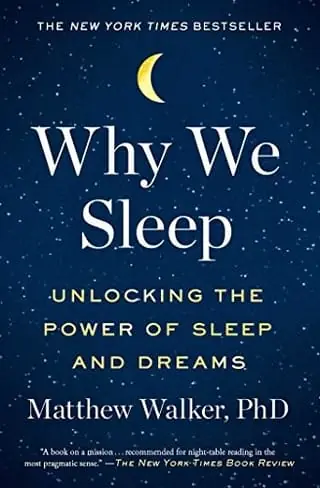
Why We Sleep summary
by Matthew Walker · 2017 · 7 key ideas · 21-minute read
A sleep scientist argues that sleep is the foundation of memory, mood and physical health, and that modern life is quietly starving us of it.
Why read it
For anyone who treats sleep as optional or negotiable. It explains what actually happens in the brain at night and gives practical ways to protect it, though some of its bolder health claims are disputed.
Why We Sleep in brief
Walker opens with a provocation: sleep is the single most effective thing we can do to reset brain and body each day, yet modern societies treat it as wasted time. He argues that widespread short sleep is quietly damaging learning, mood, safety and long-term health.
The first part explains the machinery. Two forces govern when we sleep: an internal 24-hour clock and a chemical sleep pressure that builds the longer we are awake. Each night cycles between deep non-REM sleep and dreaming REM sleep, and each stage does different work.
The middle of the book tours the benefits. Deep sleep files away the day's memories and clears space for new learning; REM sleep softens painful emotions and links ideas in creative ways. Losing sleep, Walker argues, harms attention, emotional control, immunity, appetite and the heart, and makes drowsy driving dangerously common.
He then turns to dreams, sleep disorders and the forces that steal our sleep: electric light, screens, caffeine, alcohol, early school and work schedules, and a culture that admires people who sleep little. He is sceptical of sleeping pills and recommends cognitive behavioural therapy for insomnia instead.
The book closes with a call for change at every level, from bedrooms to schools, workplaces and medicine, plus practical tips. Its message is memorable, but critics have argued that some statistics and causal claims go beyond what the evidence shows.
The 7 key ideas
1. The clock and the pressure
Caffeine hides the tiredness; it doesn't pay the debt.
2. Front-loaded deep sleep, back-loaded dreams
Cut the morning, cut the dreams.
3. Sleep before learning, sleep after
Pull an all-nighter, and you erase what you crammed.
4. REM as overnight therapy
Sleep on it: dreams file the facts and dull the sting.
5. You can't feel your sleep debt
Tired brains are bad judges of tired brains.
6. Sleep as the foundation
Build the base first; everything else stacks on sleep.
7. Protecting the night
Same time, dark, cool, dry.
Read the full guide in Kinquire. Every idea with a real example, a diagram and one thing to try today, plus a quick quiz so it sticks. Free to start.
Read Why We SleepKey takeaways
- Keep the same wake-up time every day, including weekends.
- Set a caffeine cut-off in the early afternoon.
- Treat alcohol as a sleep disruptor, not a sleep aid.
- Sleep after learning to lock in what you studied; don't cram all night.
- Keep your bedroom dark and cool and get up if you can't fall asleep.
- For persistent insomnia, ask about CBT-I rather than relying on pills.
Our take
Why We Sleep made sleep science vivid and persuaded many people to take rest seriously, and its core points, that sleep supports memory, mood and safety and that chronic short sleep impairs us more than we notice, are well supported. Its weakness is overstatement. Critics, including some sleep researchers, argued that it presents observational links with disease and death as proven causes, uses some figures loosely, and can make readers anxious about sleep, which itself worsens insomnia. Studies of some pre-industrial societies also suggest humans did not always sleep eight hours. Read it for the mechanisms and habits, and treat the scariest health statistics with caution.
About Matthew Walker
Matthew Walker is a professor of neuroscience and psychology at the University of California, Berkeley, where he founded the Center for Human Sleep Science.
If you liked this
- Outlive by Peter Attia with Bill Gifford
- Spark by John J. Ratey with Eric Hagerman
- Born to Run by Christopher McDougall
- How Not to Die by Michael Greger with Gene Stone
- The Body: A Guide for Occupants by Bill Bryson
- Lifespan by David A. Sinclair with Matthew D. LaPlante