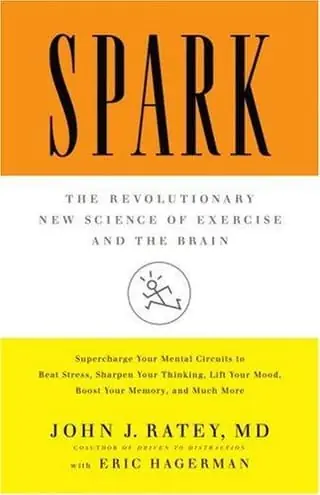
Spark summary
by John J. Ratey with Eric Hagerman · 2008 · 7 key ideas · 18-minute read
A psychiatrist argues that exercise is one of the most powerful things you can do for your brain, improving learning, mood, focus and resilience to stress.
Why read it
For anyone who exercises for their waistline but not their mind, or who struggles with stress, low mood or focus. It reframes a run or a workout as brain medicine, while some of its specific neuroscience claims are simplified.
Spark in brief
Ratey's core argument is that we've misunderstood exercise. We think of it mainly in terms of the body, weight, heart and muscles, but its effects on the brain may be even more important. Movement, he argues, changes brain chemistry and structure in ways that improve how we think and feel.
He starts with a school district in Illinois that made fitness-focused physical education a priority, and reports striking gains in student fitness and academic performance. He then explains the biology: exercise boosts neurotransmitters and growth factors, especially a protein called BDNF, which helps neurons grow and connect.
The middle chapters apply this to specific problems: stress, anxiety, depression, attention deficit disorder, addiction, hormonal changes in women, and the ageing brain. In each, Ratey presents research suggesting that regular exercise can help, sometimes as much as standard treatments in certain studies.
His explanation for why exercise matters so much is evolutionary. Human brains evolved in bodies that had to move a lot to survive, so movement and thinking are deeply linked. Sedentary modern life deprives the brain of signals it was built to expect.
He ends with a practical prescription: regular aerobic exercise on most days of the week, some higher-intensity sessions, and activities that involve skill and coordination, which challenge the brain as well as the body. The goal is not athletic performance but a brain that is better fed, calmer and readier to learn.
The 7 key ideas
1. Exercise is for your brain
Exercise is brain training in disguise.
2. Miracle-Gro for the brain
Move first, then learn.
3. Train the brain with skill
Sweat to grow it, learn to keep it.
4. Stress inoculation
Small doses of stress make you stronger against big ones.
5. Exercise as medicine for mood
Move when you least feel like it; that's when it works.
6. Focus, attention and cravings
Get the body moving to get the mind still.
7. Keep moving, keep sharp
Legs moving, mind growing, at any age.
Read the full guide in Kinquire. Every idea with a real example, a diagram and one thing to try today, plus a quick quiz so it sticks. Free to start.
Read SparkKey takeaways
- Exercise most days, treating it as brain care as well as body care.
- Do a short burst of activity before demanding mental work.
- Add activities that require skill, like dance, martial arts or racket sports.
- Use exercise as part of managing stress, anxiety and low mood, alongside professional help when needed.
- Keep moving and socialising as you age to protect your brain.
Our take
Spark was ahead of its time in popularising the link between exercise and mental health, and its core message, that physical activity improves mood, stress resilience and brain health, has been strongly supported by research since. Its weaknesses are in the details. Ratey sometimes leaps from animal studies to human advice, presents single programmes like Naperville as proof, and simplifies neuroscience into tidy stories about BDNF and neurotransmitters. Effects in humans are real but often more modest than the book's enthusiasm implies. Read it as an inspiring, broadly correct case for moving more, not a precise scientific account.
About John J. Ratey with Eric Hagerman
John Ratey is a psychiatrist and associate clinical professor of psychiatry at Harvard Medical School. He co-wrote Driven to Distraction, a well-known book on ADHD.
If you liked this
- Outlive by Peter Attia with Bill Gifford
- Why We Sleep by Matthew Walker
- Born to Run by Christopher McDougall
- How Not to Die by Michael Greger with Gene Stone
- The Body: A Guide for Occupants by Bill Bryson
- Lifespan by David A. Sinclair with Matthew D. LaPlante