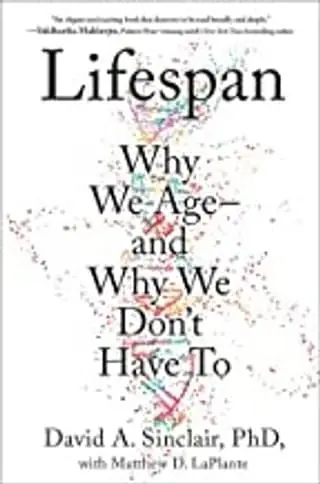
Lifespan summary
by David A. Sinclair with Matthew D. LaPlante · 2019 · 7 key ideas · 20-minute read
A Harvard geneticist argues that ageing is caused by a loss of information in our cells, that it should be treated as a disease, and that it may one day be slowed or even reversed.
Why read it
For anyone curious about the science of ageing and where longevity research might be heading. It is a bold, optimistic vision; many of its specific claims, especially about supplements, are disputed or unproven in humans.
Lifespan in brief
Sinclair begins with a challenge to how we think about getting old. We treat ageing as natural and inevitable, and treat its diseases one at a time. He argues instead that ageing itself is the root cause of most chronic illness and should be considered a disease that can be treated.
The first part sets out his 'information theory of ageing'. Our cells hold two kinds of information: the genetic code, and the epigenetic settings that tell each cell which genes to use. Sinclair argues that ageing is mainly the gradual loss of that epigenetic information, as cells repeatedly repair damage and lose track of their identity.
He describes 'longevity genes', including the sirtuins he has long studied, which help protect cells and are switched on by adversity such as hunger and exercise. This leads to lifestyle advice: eat less often, eat less animal protein, exercise, expose yourself to cold, and avoid DNA-damaging exposures.
The second part looks to the future: molecules that might mimic these effects, such as NAD boosters, metformin and rapamycin; and experiments that partly reset cells' epigenetic clocks. The final part considers what a world of much longer lives would mean for society, from population and economics to inequality.
The book is ambitious, readable and genuinely exciting about where science might go. But it mixes established biology with Sinclair's own contested hypotheses and early results in yeast and mice, and he has commercial interests in the longevity field, so its boldest claims deserve careful reading.
The 7 key ideas
1. Ageing as a disease
Don't chase the moles; switch off the machine.
2. The information theory of ageing
The music's still on the disc; the scratches are ageing.
3. The survival circuit
Every repair has a cost; ageing is the bill.
4. A little adversity is good for you
Gentle hardship keeps the guards awake.
5. Eat less, and less often
Hunger now and then; not hunger always.
6. Longevity molecules: promising, unproven
Mice aren't men, and pills aren't proof.
7. Resetting the clock
Reset the settings, keep the code.
Read the full guide in Kinquire. Every idea with a real example, a diagram and one thing to try today, plus a quick quiz so it sticks. Free to start.
Read LifespanKey takeaways
- Think of ageing as a process you can influence, not just a series of separate diseases.
- Exercise hard sometimes; it is the best-supported 'mild stress' in the book.
- Avoid constant snacking, but don't skimp on protein if you are older.
- Avoid smoking and unnecessary exposure to DNA-damaging radiation and chemicals.
- Be sceptical of longevity supplements until large human trials show benefits.
Our take
Lifespan is a lively, optimistic introduction to the biology of ageing, and its core idea, that ageing might be targeted directly rather than disease by disease, has serious scientific support. Its weaknesses lie in certainty and conflicts of interest. Sinclair presents his own information theory and sirtuin research as more settled than they are, leans on results in yeast and mice, and discusses supplements in ways that critics say encourage unproven self-experimentation. He also has commercial ties to longevity companies. Read it as one prominent scientist's bold vision, and keep the reliable advice, such as exercise, not smoking and healthy eating, separate from the speculation.
About David A. Sinclair with Matthew D. LaPlante
David Sinclair is an Australian-born biologist and professor of genetics at Harvard Medical School who researches ageing. Matthew LaPlante is a journalist and writer.
If you liked this
- Outlive by Peter Attia with Bill Gifford
- The Emperor of All Maladies by Siddhartha Mukherjee
- Why We Sleep by Matthew Walker
- Born to Run by Christopher McDougall
- How Not to Die by Michael Greger with Gene Stone
- The Body: A Guide for Occupants by Bill Bryson