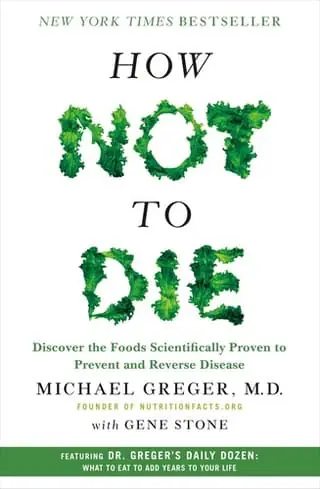
How Not to Die summary
by Michael Greger with Gene Stone · 2015 · 7 key ideas · 19-minute read
A physician argues that a diet built on whole plant foods can help prevent, and sometimes treat, many of the leading causes of early death.
Why read it
For anyone who wants a practical, plant-heavy way of eating and a checklist to follow. It is strong on the benefits of eating more whole plant foods, but it argues one side of a debate and its strongest claims go beyond the scientific consensus.
How Not to Die in brief
Greger's starting point is personal. His grandmother was sent home with severe heart disease and little hope, then recovered dramatically after adopting a strict low-fat, plant-based diet under the nutrition pioneer Nathan Pritikin. Greger says this is what led him into medicine and nutrition.
The first half of the book walks through fifteen leading causes of death in the United States, from heart disease and lung cancer to diabetes, kidney disease and depression. For each, Greger gathers studies suggesting that diet, particularly a whole-food, plant-based diet, can lower the risk or improve the condition.
His central argument is that most early deaths are driven by lifestyle rather than genes, and that doctors underuse the most powerful tool they have: food. He is critical of a medical system that relies on pills and procedures and rarely trains doctors in nutrition.
The second half turns this into practice. Greger introduces a traffic-light system for foods and his Daily Dozen, a checklist of foods and habits to tick off each day, such as beans, berries, greens, flaxseed, nuts, whole grains, water and exercise.
The book is energetic and packed with references, but it is also advocacy. Greger's conclusion that the healthiest diet contains few or no animal products is contested by many nutrition scientists, even though the advice to eat more whole plant foods is widely shared.
The 7 key ideas
1. Lifestyle, not fate
Genes load the gun; lifestyle often pulls the trigger.
2. The traffic-light plate
If it still looks like a plant, it's probably green.
3. The Daily Dozen
Crowd out the bad by adding the good.
4. Food against heart disease
Keep the pipes clear: more fibre, less saturated fat.
5. Processed meat is the clearest red light
Cured, smoked or packaged meat: make it rare.
6. Small foods, big claims
Ordinary foods, eaten daily, beat exotic supplements.
7. Plates before pills
Ask what's on your plate before what's in the pillbox.
Read the full guide in Kinquire. Every idea with a real example, a diagram and one thing to try today, plus a quick quiz so it sticks. Free to start.
Read How Not to DieKey takeaways
- Make whole plant foods the base of most meals.
- Use a daily checklist to add beans, berries, greens, nuts and whole grains.
- Treat processed meat and ultra-processed foods as occasional at most.
- If you eat fully plant-based, take a vitamin B12 supplement.
- Ask your doctor about lifestyle options alongside, not instead of, prescribed treatment.
Our take
How Not to Die makes a powerful case for eating more vegetables, fruit, beans, whole grains and nuts and for cutting processed meat and ultra-processed food, advice that matches most expert guidance. Its Daily Dozen is a genuinely useful tool. Its weakness is one-sidedness. Greger, a long-time vegan advocate, tends to present evidence that supports a fully plant-based diet while giving less weight to research showing good outcomes for diets that include fish, eggs or dairy. Critics say he sometimes overstates small or preliminary studies. Treat it as a strong argument for plant-rich eating, not proof that all animal foods are harmful.
About Michael Greger with Gene Stone
Michael Greger is an American physician and the founder of the nutrition website NutritionFacts.org. The book was co-written with the writer Gene Stone.
If you liked this
- In Defense of Food by Michael Pollan
- Outlive by Peter Attia with Bill Gifford
- Ultra-Processed People by Chris van Tulleken
- Why We Sleep by Matthew Walker
- Born to Run by Christopher McDougall
- The Body: A Guide for Occupants by Bill Bryson